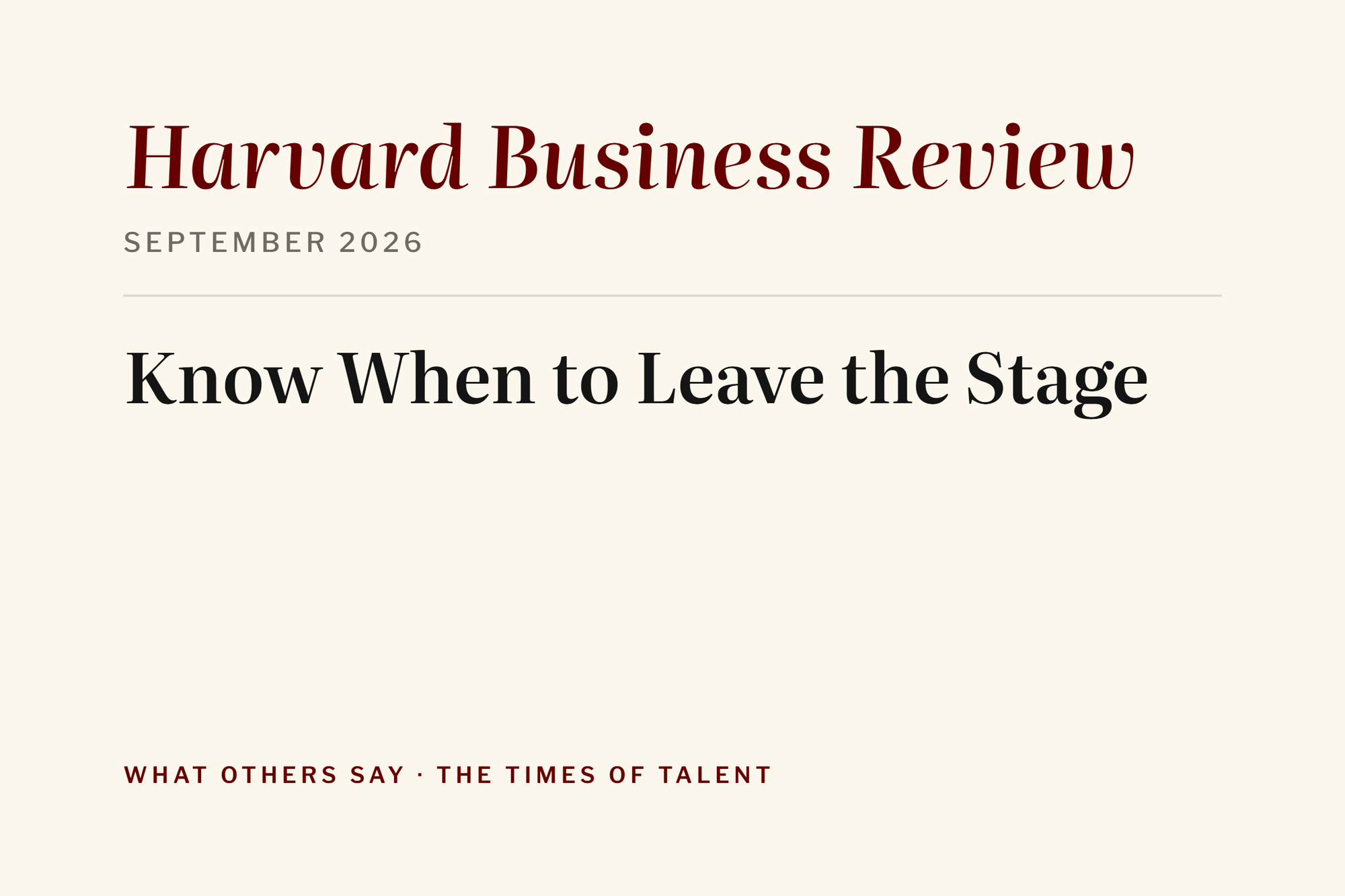
Craig Newmark built Craigslist and then stepped back from running it. In a Harvard Business Review conversation with editor-at-large Adi Ignatius, he talks about recognizing the limits of your own leadership and leaving before it costs the company.
The piece belongs to HBR's Executive Agenda series and turns on one question: when is it time to step down? Newmark's answer, as HBR frames it, is to step aside proactively — to see the point at which your presence starts to hold the organization back, and to act before others have to.
His point opens a theme that leadership development often leaves aside. Most programs focus on adding: skills, scope, responsibility. Preparing people to make themselves less necessary gets far less attention. Yet the leaders who develop others well tend to do exactly that over time, and they plan for it.
The idea is old. Laozi's Tao Te Ching describes the best leader as one whose people, when the work is done, say they did it themselves. Liz Wiseman's research on "multipliers" gives it a modern form: leaders who draw out the capability of others get more from their teams than leaders who stay at the center of every decision.
Succession research adds a practical note. A study of principal succession in 113 U.S. elementary schools, published this year in the Journal of Applied Psychology, found that a successor's coaching lifted engagement and performance when staff saw a need for change — and lowered both when they did not. How and when a leader hands over matters as much as the decision to go.
Stepping down well is itself a development task. It starts years before the exit, with people who are ready to take over.
Talent Takeaway
Ask every senior leader one question in their next development conversation: if you left in twelve months, who would be ready, and what are you doing about it this quarter?
Read the original at Harvard Business Review
Sources
Ignatius, A. (2026, September 18). When is it time to step down? Harvard Business Review. https://hbr.org/2026/09/when-is-it-time-to-step-down
Klein, K. J., et al. (2026). For good and for bad: The distinctive effects of successors' leadership behavior on collective engagement and organizational performance. Journal of Applied Psychology. https://doi.org/10.1037/apl0001359
Further reading
Wiseman, L. (2010). Multipliers: How the best leaders make everyone smarter. HarperBusiness.