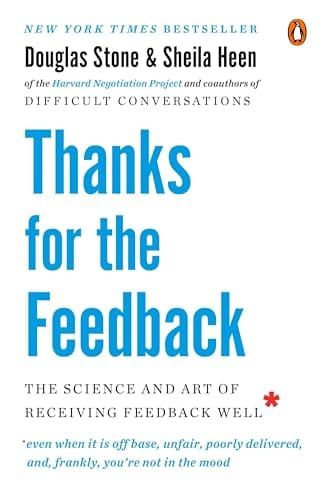
Harvard negotiation experts Douglas Stone and Sheila Heen turn our attention to the person on the receiving end of feedback. They sort feedback into three kinds: appreciation, coaching and evaluation. Many tricky conversations get easier once both people know which of the three they are having.
They also name three triggers that make us stop listening. Truth: we think the feedback is wrong. Relationship: we have doubts about the person giving it. Identity: it shakes how we see ourselves. Knowing the three helps us notice the moment when we start defending and helps us get back to listening.
Talent Takeaway
It reminds us that feedback lands best when we ask for it. Before your next one-on-one, try a question in the spirit of the book: What's one thing you see me doing, or not doing, that gets in my way? And when a comment stings, a quiet "Which trigger is this?" buys a few seconds of calm.
Our Take
Our pick for anyone who runs performance conversations. It turns receiving feedback into a skill we can all practice, and that makes giving feedback easier too.
Stone, D., & Heen, S. (2014). Thanks for the feedback: The science and art of receiving feedback well. Viking. Find it