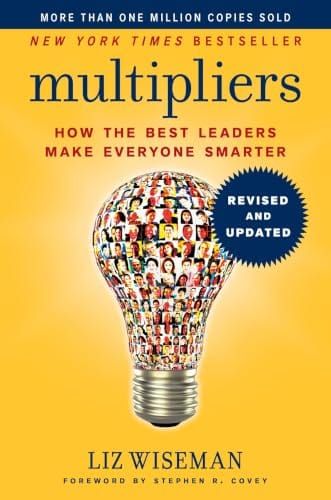
In 1988, Liz Wiseman took a job at Oracle. She stayed seventeen years, eventually led Oracle University, and kept running into the same puzzle: some managers made the people around them sharper, while others seemed to drain the room.¹ Years later she turned that puzzle into research, and into a book many of us keep within reach: Multipliers.
If we develop people for a living, or simply lead a team, Wiseman's question is our daily business: What happens to other people's intelligence when we walk into the room?
Two Kinds of Leader
Together with Greg McKeown, Wiseman studied more than 150 leaders and sorted them into two groups.² Diminishers rely on their own intelligence and tend to underuse the people around them. Multipliers draw out the intelligence of others.
"Multipliers are genius makers."LIZ WISEMAN
Her headline finding is easy to remember. People told her they gave diminishers a fraction of their capability, and gave multipliers nearly all of it. On average, multipliers got 1.97 times as much out of the same people.² Same team, same budget, roughly double the brainpower.
Five Disciplines
Wiseman describes five disciplines, each with a diminishing twin.¹
Talent Magnet. Attracts people and uses them at their highest point of contribution. The twin, the Empire Builder, hoards talent and underuses it.
Liberator. Creates an intense environment in which people have room to think and are expected to do their best thinking. The twin is the Tyrant.
Challenger. Defines an opportunity that stretches people beyond what they think they can do. The twin is the Know-It-All, who sets direction alone.
Debate Maker. Reaches sound decisions through rigorous debate. The twin, the Decision Maker, decides in a small circle.
Investor. Gives people real ownership of results and invests in their success. The twin is the Micromanager.
Wiseman stresses that these are learned behaviors, which is good news for all of us who train leaders.
The Diminisher With Good Intentions
A chapter we keep returning to arrived with the revised edition of 2017: the accidental diminisher.¹ Wiseman found that much diminishing comes from well-meaning leaders whose strengths overshoot.
The Rescuer jumps in the moment someone struggles, and the person never learns to find the way out. The Rapid Responder answers every question first, so others stop thinking about it. The Idea Guy sparks five new ideas a day, and the team spends its energy chasing them. The Always-On leader fills every silence with energy, leaving little room for anyone else.
Most of us will spot ourselves on that list at least once. The good news is how practical Wiseman's remedies are. One of our favorites: go into a meeting with a small budget of poker chips, each worth one comment, and spend them wisely.¹ It is a playful way to leave room for other people's genius.
By the Numbers
17 years Wiseman spent at Oracle¹
150+ leaders in the original study²
5 disciplines of a multiplier¹
1.97 times more capability drawn out by multipliers²
One Company, Two Books
Wiseman's Oracle years hold a nice twist. Sydney Finkelstein of Dartmouth's Tuck School counts Oracle's founder, Larry Ellison, among his superbosses, the leaders whose former employees go on to run whole industries.³ We look at his research in The Bosses Who Build Other Bosses.
Read side by side, the two books tell one story at two speeds. Finkelstein zooms out to careers over decades; Wiseman zooms in to a meeting, a decision, a single well-timed question. Both describe leaders who assume their people can do more than they currently show, and who hand out stretch assignments, real ownership and constant teaching.
One tension is worth a closer look. Finkelstein's tough-minded "Glorious Bastards," Ellison among them, produce stars, while Wiseman would likely classify parts of their style as diminishing. Both observations may hold. Demanding bosses who also set very high standards, teach relentlessly and hand out real responsibility may create talent through those three habits. Research that separates the pressure from the teaching would help all of us who develop people.
What We Can Try on Monday
Spend fewer chips. In the next meeting, set yourself a budget of comments and ask more questions than you answer.
Hand back the pen. When someone brings a problem, ask what they would do before offering your view.
Name the genius. Tell one colleague what they do exceptionally well, and give them work that uses it.
Check the mirror. Ask a trusted colleague which of your strengths might be shrinking other people.
Talent Takeaway
Multipliers assume the people around them are smart and give them room to prove it. For our own teams, that means fewer answers, better questions and real ownership. A good test after any meeting: Did the people in the room do more of the thinking than we did?
¹ Wiseman, L. (2017). Multipliers: How the best leaders make everyone smarter (Rev. ed.). HarperBusiness. Get the book
² Wiseman, L., & McKeown, G. (2010). Multipliers: How the best leaders make everyone smarter. HarperBusiness.
³ Finkelstein, S. (2016, January–February). Secrets of the superbosses. Harvard Business Review. https://hbr.org/2016/01/secrets-of-the-superbosses
Further reading: Wiseman, L. (2021). Impact players: How to take the lead, play bigger, and multiply your impact. Harper Business. Get the book