Your American boss looks at your draft and says: "Awesome. Great start!"
How do you feel?
If you grew up in Ohio, you feel fine. Good, even. You know the real review is still coming.
If you grew up in Munich, you feel like a hero. Awesome! Great! You close the laptop and go home early.
Two days later, the "great start" comes back with forty comments in red.
So who got it wrong? Neither of them, really. Both spoke their language perfectly. They just used different dictionaries. Here are a few pages from each, with a wink, a bit of research and a list of habits you can use immediately.
The Great Inflation
Let's begin with the hardest-working word in American offices: great.
"Great!" with an exclamation mark can mean thrilled. "Great." with a period can mean noted. "Great…" with three dots can mean the server just went down. Awesome, amazing, love it, perfect: same family. Americans use them generously, and in daily use many of them have shrunk to something closer to "good," or simply "okay."
Linguists have a name for this: semantic bleaching. A strong word gets used so often that it loses its punch. Yiwei Luo, Dan Jurafsky and Beth Levin at Stanford traced how intensifiers like "awfully" slid from their original meaning toward a plain "very."¹ "Awesome" took a similar road. It once described something that filled you with awe. Today it describes a parking spot.
Why so much enthusiasm? Stanford psychologist Jeanne Tsai offers a clue. Her research shows that European Americans tend to value excited, high-energy feelings more than many East Asians, who often prefer calm ones.² In one set of studies, 86 percent of European Americans wanted to come across as excited in a job application, compared with 48 percent of Hong Kong Chinese.³ When a culture prizes excitement, everyday praise turns up the volume. And when everything is awesome, "awesome" becomes the new "fine."
Now hand that vocabulary to a German, a Brit or a French colleague, and watch what happens.
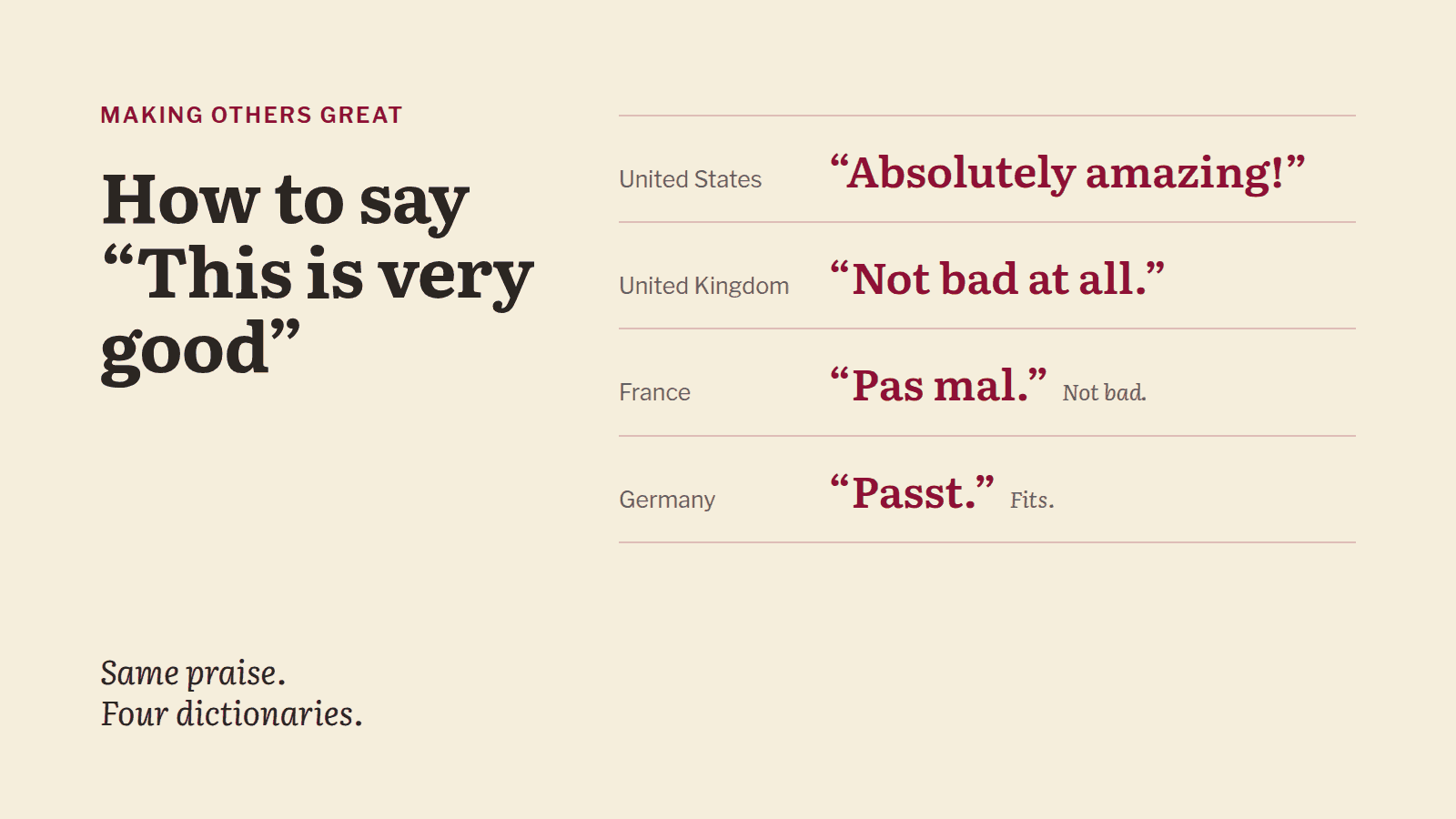
How to Say "This Is Very Good"
United States
"This is absolutely amazing!"
United Kingdom
"Not bad at all."
France
"Pas mal." (Not bad.)
Germany
"Passt." (Fits.)
Notice something? Two of the four use a negation, and the German needs exactly one syllable.
The American Dictionary
Erin Meyer, who teaches at INSEAD, describes a pattern many Europeans know from their first American job: several positives for every negative, criticism wrapped in compliments, and "overall, great work" before the point.⁴ Friendly? Very. Clear? That depends on who is listening.
American English, Decoded
| They say | They often mean | A German may hear |
|---|---|---|
| "That's a great start!" | Keep going, there's real work ahead. | Almost done. |
| "Interesting." | I have doubts. | They find it fascinating. |
| "Love it! Just a few small tweaks." | Brace for substantial changes. | Two typos. |
| "That's a bold idea." | Risky. Probably too risky. | They admire my courage. |
| "Let's circle back on this." | Not now. Maybe not ever. | Next week, same topic. |
| "I hear you." | I understand, and I still disagree. | We agree. |
| "We should grab lunch sometime!" | Nice seeing you. | A calendar invite is coming. |
| "How are you?" | Hello. | A request for a health update. |
With a wink. Usage varies by region, company and person.
That last line deserves a footnote, and it has one. The anthropologist Bronisław Malinowski coined the term "phatic communion" for talk whose job is to create a bond, with information optional.⁵ "How are you?" is a handshake in words. Germans tend to answer it like a medical questionnaire, and both sides walk away slightly confused.
The German Dictionary
German business talk sits at the other end. The linguist Juliane House, who has compared German and English for decades, describes German communication as oriented toward content and English as oriented toward the listener.⁶ In practice: Germans talk about the work. The relationship is assumed to survive.
And praise? A Swabian proverb sums it up: "Nicht geschimpft ist genug gelobt." Not scolded is praised enough.
German, Decoded
| They say | They often mean | An American may hear |
|---|---|---|
| "Passt." (Fits.) | Excellent. Done. Thank you. | They couldn't care less. |
| "Nicht schlecht." (Not bad.) | That's really good. | Mediocre. |
| "Kann man so machen." (One can do it that way.) | …but please don't. | Approved. |
| "Ich hätte da mal eine kurze Frage." (Just a quick question.) | We found a problem. A big one. | A quick question. |
| "Das stimmt so nicht ganz." (That's not quite right.) | That's wrong. | A minor detail. |
| "Ja, aber…" (Yes, but…) | No. | Yes. |
| Silence after your presentation | It was fine. No questions. | It bombed. |
| "Mahlzeit!" (at 11:45 a.m.) | Hi, enjoy your lunch. | Are they hungry? Is this a threat? |
With a wink. Bavaria, Berlin and Hamburg would each add their own column.
Here is the twist. In German, directness is often a form of respect. Telling you clearly what is wrong means taking you and your work seriously. The Israeli scholar Tamar Katriel found a similar logic in Israeli dugri speech: straight talk as a sign of sincerity and closeness.⁷ Seen from Chicago, the same words can feel like a slap.
The French Dictionary
France plays a clever double game. In everyday conversation, a lot happens between the lines; Edward T. Hall would call it a fairly high-context culture.⁸ When it comes to criticism, Meyer finds the French considerably more direct than Americans, and sparing with praise.⁴ Many French professionals grew up with essays returned covered in red ink. A "pas mal" from a French manager can be a small triumph.
French, Decoded
| They say | They often mean | Others may hear |
|---|---|---|
| "Pas mal." (Not bad.) | Quite good. Sometimes very good. | Barely okay. |
| "C'est intéressant." (That's interesting.) | Real interest or polite doubt. Watch the eyebrows. | Interest. |
| "Bof." | Meh. Not convinced. | A sound. Possibly a sneeze. |
| "Pourquoi pas ?" (Why not?) | Okay, let's try it. | A request for reasons. |
| "On verra." (We'll see.) | Probably not. | Decision pending. |
| "Ce n'est pas évident." (It's not obvious.) | That will be hard. Perhaps impossible. | It needs a better explanation. |
| "C'est pas faux." (That's not false.) | Fair point. Or: I didn't follow a word.* | Faint praise. |
* Fans of the TV series Kaamelott know this as the line the knight Perceval uses whenever he has not understood. With a wink, as always.
Quick Stops Along the Way
The British earned their own famous table long ago. In the late 1990s, the Dutch mobility expert Nannette Ripmeester drew up a guide to what the British say, what they mean and what the Dutch understand. "Quite good" can mean a little disappointing. "I'll bear it in mind" can mean I have already forgotten it. "With the greatest respect" can mean you are a fool.⁹
In Japan, "kentō shimasu" ("we will consider it") is frequently a polite no. So is a long "chotto…" ("it's a little…") that never finishes its sentence. And in the Netherlands, a colleague who calls your plan "not smart" may simply be trying to help you before lunch.
Why the Laughter Matters
All of this is funny until it lands on someone's career. Avraham Kluger and Angelo DeNisi analyzed decades of feedback research and found that in more than a third of the cases, feedback made performance worse.¹⁰ A word read on the wrong scale is one easy way to end up in that third.
Language adds another layer. Most international teams work in English, and for many members it is a second or third language. The linguist István Kecskés has shown that people speaking a second language tend to take the literal meaning of a sentence as its real meaning.¹¹ So "great start" means great. And "maybe have another look" means maybe.
The good news: nobody needs to memorize every dictionary. A handful of habits does most of the work.
Seven Habits for Feedback That Survives Translation
Trade adjectives for numbers. "On a scale from 1 to 10, where is this draft today?" A 6 reads the same in Boston, Berlin and Bordeaux.
Give the verdict before the vibe. "Ready to send? Not yet. Here's why." Then add all the warmth you like.
Name the next step. "Please rework section 2 by Friday" travels better than "maybe take another pass."
Repeat it back. "So you'd like me to shorten the intro and redo the chart. Did I get that right?" Ten seconds that can save a week.
Add your own subtitles. "Where I grew up, 'not bad' is high praise." Saying it out loud invites the other person to share their dictionary too.
Decode with a margin. When you hear American praise, it can help to turn it down a notch. When you hear British, German or French understatement, turn it up a notch. Then check (see habit four).
Build a team glossary. Ask your team: Which phrases do we use that newcomers misread? Write them down. In our experience, it is one of the most enjoyable team meetings of the year, and one of the most useful.
Your Turn
Every culture, region and company has its own entries. What's yours? Which phrase from your country, your industry or your office keeps getting lost in translation? Tell us. We're collecting them, and the best ones will make it into the next edition of this dictionary.
Talent Takeaway
- The same word can sit at different points on the praise scale. "Awesome," "passt" and "pas mal" can all mean very good.
- Use numbers and a clear verdict, then add warmth.
- Name the next step in one plain sentence.
- Repeat back what you heard.
- Collect your team's own dictionary, and laugh about it together.
¹ Luo, Y., Jurafsky, D., & Levin, B. (2019). From insanely jealous to insanely delicious: Computational models for the semantic bleaching of English intensifiers. Proceedings of the 1st International Workshop on Computational Approaches to Historical Language Change. https://aclanthology.org/W19-4701/
² Tsai, J. L. (2017). Ideal affect in daily life: Implications for affective experience, health, and social behavior. Current Opinion in Psychology, 17. https://pmc.ncbi.nlm.nih.gov/articles/PMC5659332/
³ Bencharit, L. Z., Ho, Y. W., Fung, H. H., Yeung, D. Y., Stephens, N. M., Romero-Canyas, R., & Tsai, J. L. (2019). Should job applicants be excited or calm? The role of culture and ideal affect in employment settings. Emotion. https://www.kellogg.northwestern.edu/academics-research/research/detail/2019/should-job-applicants-be-excited-or-calm-the-role/
⁴ Meyer, E. (2014). The culture map: Breaking through the invisible boundaries of global business. PublicAffairs. See also Meyer, E. (2015, September 16). Giving negative feedback across cultures. INSEAD Knowledge. https://knowledge.insead.edu/leadership-organisations/giving-negative-feedback-across-cultures
⁵ Malinowski, B. (1923). The problem of meaning in primitive languages. In C. K. Ogden & I. A. Richards, The meaning of meaning. Kegan Paul.
⁶ House, J. (2006). Communicative styles in English and German. European Journal of English Studies. https://doi.org/10.1080/13825570600967721
⁷ Katriel, T. (1986). Talking straight: Dugri speech in Israeli Sabra culture. Cambridge University Press.
⁸ Hall, E. T. (1976). Beyond culture. Anchor Press/Doubleday.
⁹ Green, D. (2021, May 20). What Brits say v what they mean, now with author credit. From Poverty to Power. https://frompoverty.oxfam.org.uk/what-brits-say-v-what-they-mean-now-with-author-credit/
¹⁰ Kluger, A. N., & DeNisi, A. (1996). The effects of feedback interventions on performance: A historical review, a meta-analysis, and a preliminary feedback intervention theory. Psychological Bulletin, 119(2), 254–284. https://doi.org/10.1037/0033-2909.119.2.254
¹¹ Kecskés, I. (2017). Context-dependency and impoliteness in intercultural communication. Journal of Politeness Research. https://doi.org/10.1515/pr-2015-0019