Little Greats are the tiny leaps in someone's development. The first question asked in a big meeting. The feedback that lands a little better than last week. The email that finally says what it means. From the outside, these moments look small. For the person who made them, they often feel like a leap. And when a leader notices them, names them and celebrates them, people tend to take the next one sooner.
Why "greats"? In English, the greats are people who made it: the jazz greats, the all-time greats. Little Greats holds both meanings. It names the little moments, and it names the people who are growing through them. In Making Others Great, we use the term for exactly this part of the job: spotting the tiny leaps of others.
Where it comes from
Three lines of research meet here. Karl Weick wrote in 1984 about "small wins": breaking big problems into concrete, doable results that build momentum.¹ Teresa Amabile and Steven Kramer later studied nearly 12,000 diary entries from 238 knowledge workers. Of all the events that marked their best days at work, making progress in meaningful work stood out most often, even when the progress was small.²
The third line explains why celebrating matters. Barbara Fredrickson's broaden-and-build theory shows that positive emotions widen what we notice and consider, and over time build lasting resources: skills, confidence, relationships.³ With Thomas Joiner she found that positive emotions and broader thinking can feed each other in an upward spiral.⁴
The loop
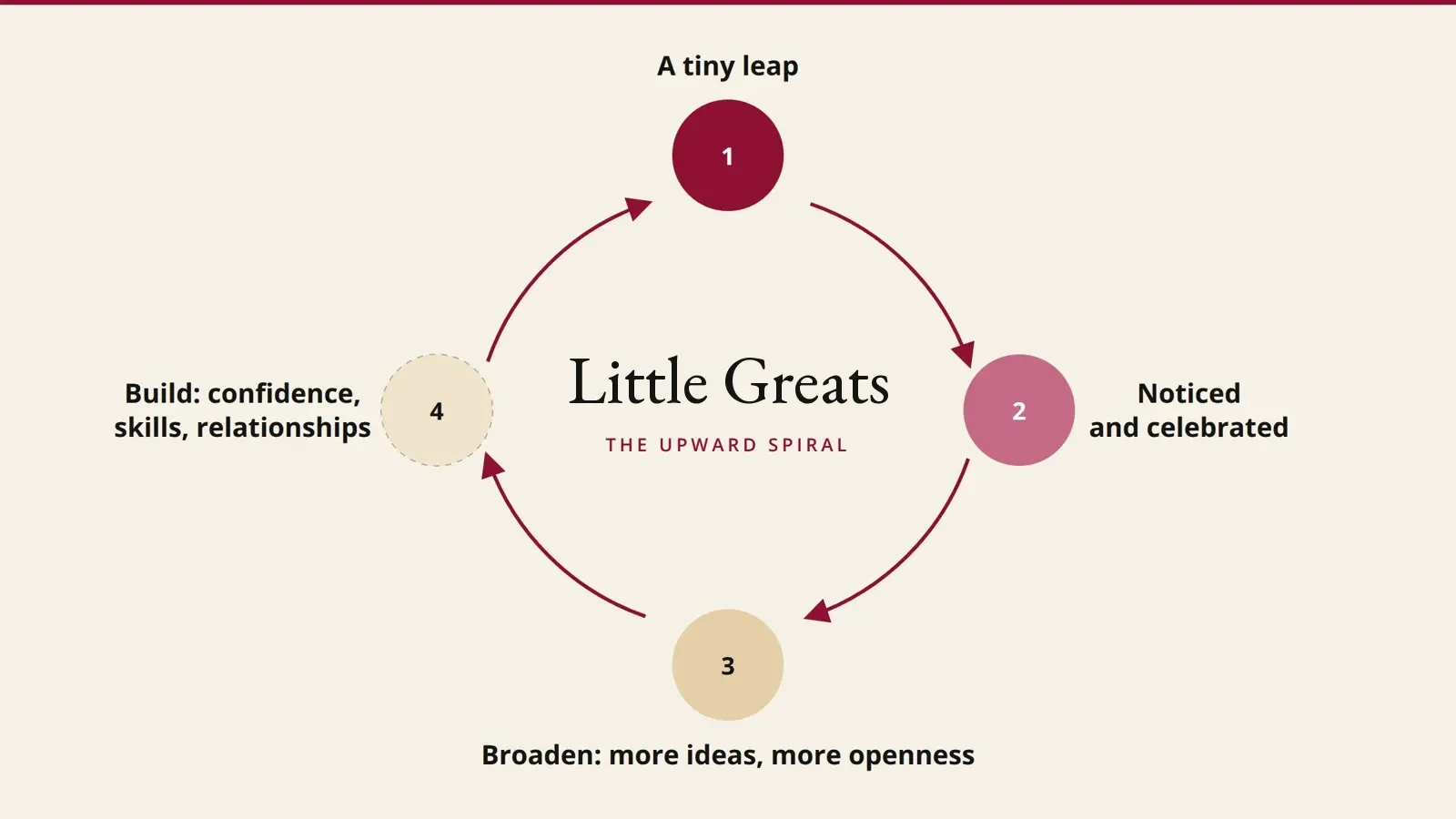
A tiny leap happens. Someone notices it and says so. The good feeling opens the mind: more ideas, more openness, more willingness to try. That builds confidence and skill. And the next leap gets a little easier. Leaders sit at the second step of this loop, and it costs them almost nothing.
Where it goes wrong
Celebration works best when it is specific. "Great job" fades fast. "You asked the question nobody dared to ask, and it changed the meeting" stays. Little Greats also belong to the person who made them, so the most useful celebrations tend to be short, sincere and close to the moment. Big speeches about small leaps can make people shrink.
Talent Takeaway
- Pick one person on your team and watch for one tiny leap this week.
- Name it in one specific sentence, close to the moment.
- Ask what made it possible. That turns one leap into the next.
¹ Weick, K. E. (1984). Small wins: Redefining the scale of social problems. American Psychologist, 39(1), 40–49. https://doi.org/10.1037/0003-066X.39.1.40
² Amabile, T. M., & Kramer, S. J. (2011). The progress principle: Using small wins to ignite joy, engagement, and creativity at work. Harvard Business Review Press.
³ Fredrickson, B. L. (2001). The role of positive emotions in positive psychology: The broaden-and-build theory of positive emotions. American Psychologist, 56(3), 218–226. https://doi.org/10.1037/0003-066X.56.3.218
⁴ Fredrickson, B. L., & Joiner, T. (2002). Positive emotions trigger upward spirals toward emotional well-being. Psychological Science, 13(2), 172–175. https://doi.org/10.1111/1467-9280.00431