A Stanford professor invites the leadership field to measure itself by results — an invitation worth accepting.
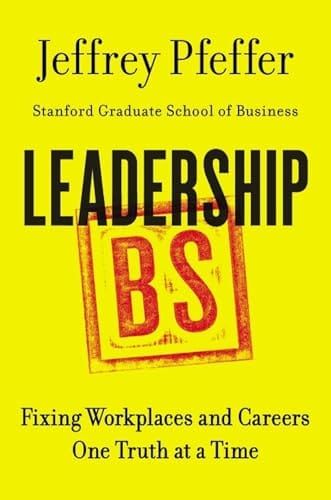
Jeffrey Pfeffer has taught organizational behavior at Stanford's Graduate School of Business since 1979, where he holds the Thomas D. Dee II professorship. Across fifteen books — among them Power, The Human Equation and The Knowing-Doing Gap, written with Robert Sutton — he has returned to one steady question: what actually happens inside organizations, and what would help the people who work in them. Leadership BS, a finalist for the 2015 Financial Times and McKinsey Business Book of the Year, turns that question toward the field many of our readers work in.
The starting point is sobering and fair. Organizations spend billions each year on leadership development, and the field has produced thousands of books, blogs and talks. Surveys, meanwhile, keep reporting disengaged employees, short leader tenures and derailed careers. Pfeffer asks a question every learning professional will recognize from budget season: with an investment this large, where can we see the results?
Five virtues, looked at closely
Pfeffer then works through the qualities the leadership literature most often prescribes, one chapter each, and sets them beside what research shows about how careers unfold.
Modesty. Self-promotion and confidence tend to carry people into senior roles. The humble leader of the case studies exists, and Pfeffer shows us how uncommon that profile is at the top.
Authenticity. Leading often asks people to play a role that differs from their natural temperament. His example is Alison Davis-Blake, a quiet doctoral student who became a highly visible business-school dean by learning to act the part the job required.
Truthfulness. Leaders frequently shade the truth, and some widely admired figures did so for good ends. Pfeffer asks us to see that clearly and to prepare people for it.
Trust. Trust in leaders has fallen, and he connects part of that decline to the distance between how leaders are described and how they behave.
Putting others first. Simon Sinek gave this ideal a memorable image in his 2014 book Leaders Eat Last, drawn from the Marine Corps custom of officers taking their meal after their troops. Pfeffer takes up that image in a chapter of his own, looks at the incentives most leaders actually face and helps us understand why the ideal is hard to live.
A book written with care
The title is sharp; the book underneath it is thoughtful. Pfeffer writes as someone who cares deeply about the people who work for difficult bosses — he compares toxic workplaces to secondhand smoke — and about the careers that stall when people treat inspiring stories as a map. His remedy is practical: look at the evidence, judge leadership by outcomes such as engagement, retention and health, and prepare people for organizations as they are.
It is a genuine gift to our field that a scholar of Pfeffer's standing took the time to write this book. A discipline grows stronger when someone who knows it well asks it hard questions, and Pfeffer does so with data, wit and goodwill.
Talent Takeaway
For anyone who designs development programs, a look into Professor Pfeffer's book can be a real help. Three of his questions travel especially well. What outcome will change, and how will we know? Which of our favorite leadership ideals rests on evidence, and which on a good story? What do participants need to succeed in the organization they actually work in?
The chapters also lend themselves to lively discussion. A group of experienced managers asked whether modesty helped their careers will often have a candid — and very useful — conversation.
Our Take
A thought-provoking and extremely well-researched book. Pfeffer sets the virtues our field likes to teach — modesty, authenticity, truthfulness, trust and putting others first — beside the evidence on how careers really unfold. That is what makes it so helpful: it invites all of us to test the things we say most often against the research and to keep what holds up. The credibility of our field rests on exactly that habit.
Pfeffer, J. (2015). Leadership BS: Fixing workplaces and careers one truth at a time. HarperBusiness. Find it