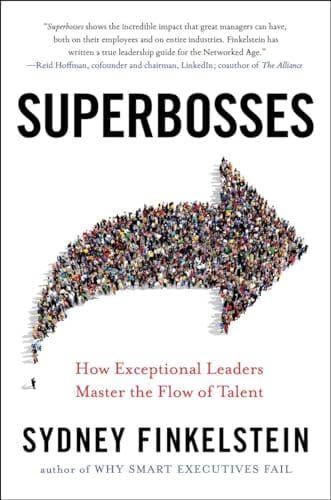
When Julian Robertson closed his hedge fund, Tiger Management, in 2000, he had already built something that would outlast it. His former analysts had started funds of their own, so many that Wall Street gave them a nickname: the Tiger Cubs. Robertson stayed close to them, kept working with them and often invested in their funds.¹ To Sydney Finkelstein, that is what a superboss looks like.
Finkelstein, a management professor at Dartmouth's Tuck School of Business, started with a pattern he could not ignore. When he looked at the leading figures in an industry, a striking number had once worked for the same boss.² By his count, as many as a third of the top fifty leaders in a field can trace their careers back to one of these figures.¹
If we develop people for a living, or simply lead a team, his book Superbosses offers a practical answer to a question we face every week: What does a leader do that makes other people grow?
A Surprisingly Varied Cast
Finkelstein spent ten years and more than two hundred interviews studying these leaders.¹ His cast is wonderfully varied. Football coach Bill Walsh. Restaurateur Alice Waters of Chez Panisse. Lorne Michaels of Saturday Night Live. Fashion designer Ralph Lauren. Jazz legend Miles Davis. Oracle founder Larry Ellison, whose alumni spread so widely that one former Oracle manager joked that half of Silicon Valley was run by them.³
A kitchen in Berkeley and a trading floor in New York have little in common. The way these bosses handle talent, Finkelstein found, has a lot.
Three Temperaments, One Result
Superbosses come in different personalities, and Finkelstein sorts them into three types.²
Iconoclasts. Artists and visionaries, such as Ralph Lauren or Miles Davis, driven by a creative mission. Their people learn by working close to that vision.
Glorious Bastards. Leaders who care about winning above almost everything else. Larry Ellison is Finkelstein's prime example. They grow people because great people help them win.
Nurturers. Teachers and mentors in the classic sense, with Bill Walsh as the model. They take visible pride in their protégés' success.
We find this idea especially helpful. A leader of almost any temperament can become a talent builder. Warmth helps, and so do conviction and an appetite for winning.
Six Habits Worth Borrowing
Beneath the different personalities, Finkelstein saw a shared set of practices.¹ ²
Unlikely hires. Superbosses weigh credentials, yet they also bet on people who lack industry experience or even a college degree, as long as they show intelligence, creativity and flexibility.
Jobs cut to fit. They adapt the role to the person, rather than squeezing talent into a fixed box.
High bars. They expect a great deal and say so, which tells people they are capable of more.
Master and apprentice. They teach up close, on the job, in the flow of real work. Finkelstein has since urged every leader to make teaching a daily habit.⁴
Collegial competition. At Saturday Night Live, writers and performers are judged by how much of their material makes it on air, and nothing makes it on air without colleagues' support.¹
Warm goodbyes. When stars leave, superbosses stay in touch, and the relationship keeps paying off on both sides, as Robertson's Tiger Cubs show.¹
That last habit reminds us of Rembrandt's studio, where pupils left to become masters in styles that looked nothing like their teacher's. The network outlives the job.
By the Numbers
10 years of research¹
200+ interviews¹
3 types of superboss²
Up to 1 in 3 top leaders in a field once worked for a superboss¹
The View From the Meeting Room
Finkelstein zooms out: careers over decades, talent flowing across whole industries. Liz Wiseman, who spent seventeen years at Oracle, zooms in on what happens in a single meeting. Her book Multipliers makes a fine companion read, and we look at it in Same Team, Twice the Brainpower.
What We Can Try on Monday
Map the alumni. List five people who once worked for you. Where are they now? Call one of them this week.
Make one unlikely bet. Give a stretch assignment to someone whose résumé would not have predicted it.
Teach on the job. Pick one piece of real work and walk someone through how you think about it.
Plan the goodbye. Think of the person on your team most likely to outgrow the role, and ask what their next step could be.
Talent Takeaway
Superbosses measure themselves by where their people end up. For our own teams, that means bold hires, high bars, teaching in the flow of work and a warm goodbye when someone outgrows us. A good test for any leader: Do people leave our team bigger than they arrived?
¹ Finkelstein, S. (2016). Superbosses: How exceptional leaders master the flow of talent. Portfolio/Penguin. Get the book
² Finkelstein, S. (2016, January–February). Secrets of the superbosses. Harvard Business Review. https://hbr.org/2016/01/secrets-of-the-superbosses
³ Finkelstein, S., & Task, A. (2016, March 2). Secrets of the "superbosses": Larry Ellison, glorious bastard. Fortune. https://fortune.com/2016/03/02/secrets-of-the-superbosses-larry-ellison-glorious-bastard/
⁴ Finkelstein, S. (2018, January 9). Why leaders should make a habit of teaching [Audio podcast episode]. In HBR IdeaCast. Harvard Business Review. https://hbr.org/ideacast/2018/01/why-leaders-should-make-a-habit-of-teaching
Further reading: Finkelstein, S. (2019). The superbosses playbook. Portfolio. Get the book