My first job was at a bank. I handed in a report, and my boss said: "This is not good. Can you do it better, and do you want to? Otherwise someone else gets it."
Three sentences. No feedback sandwich, no development plan, no "I really appreciate your energy." Just a verdict, a question and a rather clear alternative. I have sat through a fair number of leadership programs since then. Those three sentences hold up remarkably well.
Think of the person who helped you most in your career. Chances are you can name them in under three seconds. You may have forgotten their job title. You remember the question they asked, the bar they set, the responsibility they handed you a little before you felt ready.
I call this making others great. After 25 years of working with leaders in many countries, I am convinced it decides more than almost anything else whether people grow at work. Oddly enough, hardly anyone gets trained for it.
One in five
Gallup has a sobering habit. Every year it asks people around the world how engaged they are at work. The latest answer, from 2026: 20 percent. One in five. In Europe it is 12 percent, so in a meeting of eight Europeans, statistically, one person really wants to be there. Possibly the one who called the meeting. Gallup puts the cost of all this at about $10 trillion in lost productivity, roughly 9 percent of global GDP.¹
By the Numbers
20% of employees worldwide are engaged at work (2026)
22% of managers are engaged, down from 27% a year earlier
$10 trillion in estimated productivity lost to low engagement, about 9% of global GDP
70% of the variance in engagement across business units is attributed to the manager
Sources: Gallup (2026); Gallup (2015)
The detail that caught my eye sits further down in the report. The managers themselves are losing heart. Their engagement fell from 27 to 22 percent in a single year.¹ That is bad news twice over, because Gallup has long found that at least 70 percent of the variance in engagement across business units comes down to the manager.² We may join a company. Day to day, we work for a person.
Google tried to prove managers don't matter
Google once put this to the test. Many of its engineers suspected that managers were largely unnecessary, so the company went to the data. Its Project Oxygen research found the opposite: managers mattered a great deal. And the first of the original eight behaviors of its best managers was refreshingly unglamorous. Be a good coach.³
Liz Wiseman describes a similar pattern in Multipliers. In her research, leaders who drew out the intelligence of their teams got roughly twice as much capability from the same people as leaders who did all the thinking themselves.⁴ Twice as much, same people. Any CFO should be interested.
Why learning matters, now more than ever
If you believe learning is important and contributes to your happiness, you are not alone. In a Pew Research Center survey, 73 percent of American adults called themselves lifelong learners. Of those who had pursued a personal interest, 80 percent said they did it to make their lives more interesting and full, and 87 percent said it made them feel more capable and well rounded.⁵
At work, the pattern holds. In LinkedIn's research, employees named opportunities to learn and grow as the top factor that defines an exceptional work environment. Only a few years earlier, it ranked ninth.⁶ Teams depend on learning as well. Amy Edmondson of Harvard Business School found that teams that ask questions, seek feedback and talk openly about mistakes perform better, and that this kind of learning thrives where people feel safe to speak up.⁷ Organizations live on it, too: whatever a company can do, its people had to learn first.
Needless to say, AI has made all of this more urgent. New tools arrive every few months, and somebody has to help people learn them. In most teams, that somebody is the manager.
Gallup's new report carries the subtitle The Human Side of the AI Revolution. In its U.S. data from early 2026, one of the strongest predictors of whether employees use AI frequently is whether their manager actively supports it, alongside how well the tools fit the systems people already use.¹ The licenses are paid, the software is installed, and the boss still makes a real difference. Years earlier, the economists Nicholas Bloom, Raffaella Sadun and John Van Reenen estimated that management practices account for about 30 percent of the differences in total factor productivity within and between countries.⁸ Technology sets the pace. Managers help decide whether their people keep up.
"I simply don't have the time"
When I ask leaders in workshops why they invest so little in developing their people, I hear the same four sentences in every language. "I simply don't have the time." "I'm not sure how to do it." "I tried, and it didn't work." "Nobody here gets rewarded for it." All honest, all understandable.
Most of us were promoted because we were good at our own job. Then, overnight, the job became making other people good at theirs. Training for that? Gallup notes that many managers never received what they need to coach.¹ We were handed a team and, with some luck, a better parking space.
The bigger obstacle, though, is us. I can speak from experience here. I like to give the answer myself, preferably fast. I love to invent and to build, and asking whether anyone actually needs the thing is rarely my first instinct. In workshops I meet my relatives everywhere: the expert who answers before the question is finished, the quick decider who completes other people's sentences, the kind boss who protects people from exactly the challenge that would help them grow. Our strengths got us promoted. In a development conversation, they tend to get in the way.
And then there is the organization. Where leaders are measured on output alone, development is something for after hours. Or for next year.
Why am I talking?
The leaders who are good at this rarely have more time than the rest of us. They have a few habits, and most of them involve keeping quiet.
The first is a question I give leaders for every development conversation: Why am I talking? My colleague Verena Lauffs has just published a wonderful book with exactly that title, Why Am I Talking? I need the question myself, frequently. When someone is working through a problem, ask what they have already considered. Then wait. The pause will feel long. Hold it anyway.
The second habit: assume the answer is in the room. On questions of their own growth, the person across the table usually knows their situation better than we do. And people are far more likely to act on ideas they found themselves. Ours they tend to file away.
The third: hand over the pen. People who write down their own options and next step think more concretely and follow through more often. When they take that step, notice it. Out loud.
Three questions
All you need is a colleague, a real challenge and a piece of paper. No software license required.
Ask: "Where are you right now? What's on your mind?" Listen and ask follow-up questions until you truly understand. Resist the urge to solve. Try to phrase the challenge together as a question: "How can I…?"
Ask: "What are possible ideas?" Give each of you 90 seconds to write ideas down in silence. Then share, and let the other person choose one or two favorites.
Ask: "What is the first small step, and when will you take it?" "Tomorrow at nine" works better than "soon." This last question has research behind it. A meta-analysis by Peter Gollwitzer and Paschal Sheeran, covering 94 independent tests, found that people who plan when and where they will act reach their goals considerably more often than people who only hold the intention.⁹
At my company, the Autoris Leadership Institute, we call this the ACE process: address, create, execute. It is the result of a long research project, fits between two meetings and works for a corridor conversation as well as for a development plan that runs for months.
Coach's Corner
Three phrases that keep a development conversation in the other person's hands:
"What exactly do you mean by that?"
"What else could you try?"
"And when will you take that first step?"
"I don't believe you"
Years after that first conversation at the bank, a second one had a similar effect on me. By then I was working in corporate restructuring and attending the Columbia Coaching Certification Program in New York. One of the coaches had read my assessment reports. He asked what I did for a living, and I told him. "How do you like it?" I gave him the full consultant's answer: sure, I like it, great work, fascinating cases.
"Can I give you some feedback?" Of course. I waited for the compliment. Restructuring companies by day, training as a coach on the side: I thought that was rather impressive. His answer was four words. "I don't believe you."
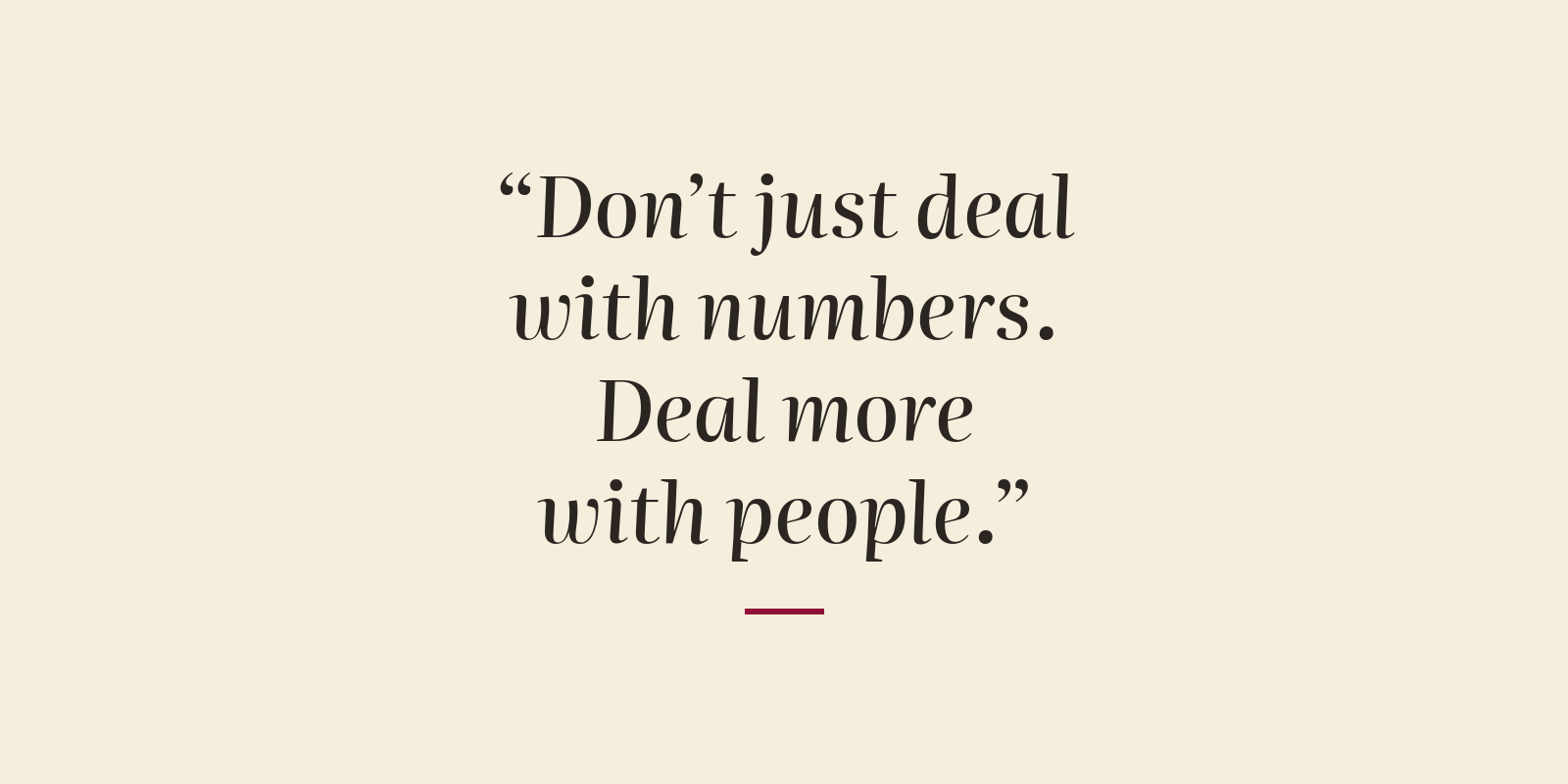
That landed. Then he asked whether he could give me one more piece of feedback. Well, since we were already at it. "Don't just deal with numbers. Deal more with people. That is what I see in all your assessments, and in you."
That landed harder. I went back and, step by step, moved my work toward what I, in fact, had cared about from the start: developing people.
One of the two asked whether I wanted to do better. The other told me what he saw and trusted me to act on it. Neither of them gave a speech. A lot of what I have learned about making others great fits into those two conversations.
So, who made you better? And who might ask that question one day and think of you?
What you can use immediately
- Think of one person on your team who has more potential than they currently show. Find time with them this week.
- Be clear about where they stand, as my boss at the bank was, and leave the next move to them.
- Use the three questions. Let them write. Hold the silence.
- End with one small, dated step, and follow up when the date arrives.
- Notice your own reflex. Do you rush to answers, to reassurance or to action? Knowing it is half the work.
Talent Takeaway
Engagement is falling, and the manager sits at the center of it. My boss at the bank set a clear standard and left the choice to me. A coach in New York told me what he saw. Developing others often starts that simply: be clear, ask a good question, hand over the pen and agree on one small step. That is a strong place to start, for all of us.
Matthias Ehrhardt is Founder and CEO of the Autoris Leadership Institute. When not teaching or researching, he enjoys writing, among others for The Times of Talent. His book Making Others Great will be published in November.
¹ Gallup. (2026). State of the global workplace: 2026 report. Gallup, Inc. https://www.gallup.com/workplace/349484/state-of-the-global-workplace.aspx
² Gallup. (2015). State of the American manager: Analytics and advice for leaders. Gallup, Inc.
³ Garvin, D. A. (2013). How Google sold its engineers on management. Harvard Business Review, 91(12), 74–82. https://hbr.org/2013/12/how-google-sold-its-engineers-on-management
⁴ Wiseman, L., & McKeown, G. (2010). Multipliers: How the best leaders make everyone smarter. HarperBusiness.
⁵ Pew Research Center. (2016). Lifelong learning and technology. https://www.pewresearch.org/internet/2016/03/22/lifelong-learning-and-technology/
⁶ LinkedIn Learning. (2022). 2022 workplace learning report: The transformation of L&D. LinkedIn. https://learning.linkedin.com/content/dam/me/learning/resources/pdfs/linkedIn-learning-workplace-learning-report-2022.pdf
⁷ Edmondson, A. (1999). Psychological safety and learning behavior in work teams. Administrative Science Quarterly, 44(2), 350–383. https://doi.org/10.2307/2666999
⁸ Bloom, N., Sadun, R., & Van Reenen, J. (2016). Management as a technology? (NBER Working Paper No. 22327). National Bureau of Economic Research. https://doi.org/10.3386/w22327
⁹ Gollwitzer, P. M., & Sheeran, P. (2006). Implementation intentions and goal achievement: A meta-analysis of effects and processes. Advances in Experimental Social Psychology, 38, 69–119. https://doi.org/10.1016/S0065-2601(06)38002-1