My child already had the backpack over one shoulder and the front door half open when the sentence came: "I don't really want to go there anymore."
Casual. Almost on the way out. One of those sentences that arrive without an announcement and carry more than they seem to. It was the wrong moment for a real conversation, so I made a mental note to come back to it. We talked later, once the door was closed and nobody was in a hurry. It turned out to be about a sports class: difficult kids, demands that felt too high, the fun long gone. Important enough to be heard.
Many meetings end the same way. Someone reaches for the button to switch off the camera, and a half-sentence slips out. A remark. A question that pretends to be something else. Then the window closes, and the moment is gone.
Listening sounds simple. In practice it competes with deadlines, notifications and our own urge to help. The stakes are real. Gallup's latest State of the Global Workplace report finds that only 20 percent of employees worldwide were engaged in 2025, down from 23 percent two years earlier. Among managers the drop was steeper, from 31 percent in 2022 to 22 percent in 2025.¹ Listening is one lever among several. It is also a lever we can pull today, in the very next conversation.
Five habits help.
1. Close Your Mouth, Open Your Ears
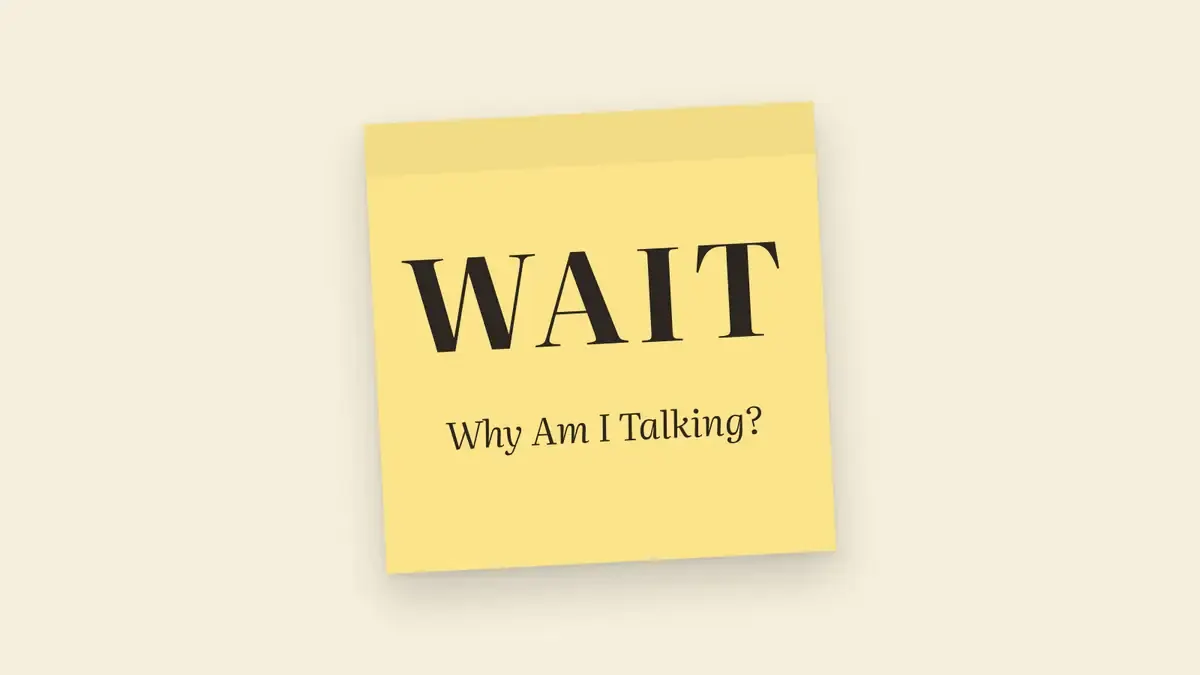
For years, a Post-it with a single word has been stuck to my desk: WAIT. It stands for "Why Am I Talking?" Sometimes talking is necessary. Sometimes a situation calls for direction. And sometimes I talk simply because the silence feels uncomfortable.
Silence gives the other person room to keep thinking. What comes after a pause is often exactly the thought that was still looking for words. In workshops, I ask a question and then we all wait eight seconds before anyone answers. Eight seconds sounds short. In the room it feels long, almost awkward. Cultures differ here: Kate Murphy notes that in Finland, jumping in too quickly can come across as impolite.²
Try this: After your next question, count to eight in your head. Let the other person fill the silence.
2. Catch the Last Sentence
The important sentences tend to come late: at the door, in the hallway, in the last seconds of a video call. They sound like an afterthought. Often they are the reason for the whole conversation.
Timing matters too. The rushed moment at the door may be the wrong one for a long talk. A calmer moment later, on the way to the cafeteria or in the five minutes before a meeting starts, can work better.
Try this: When a remark slips out on the way out, write it down and come back to it within a day or two: "Earlier you mentioned the project. Tell me more."
3. Ask, Then Let the Other Person Talk
"Have you tried X?" is advice with a question mark. It narrows the conversation to our own idea. An open question, such as "What makes this hard for you?", leaves room for an answer we had not thought of.
Coaching practice offers a rough guide for the balance: about 80 percent of the conversation belongs to the other person, 20 percent to us, for questions, short summaries and the occasional suggestion.
Try this: Before you ask, check whether you already know which answer you are hoping for. If you do, you are probably about to give advice. Ask something you are genuinely curious about instead.
4. Reflect Back Before You React
A short summary ("So you're deciding between staying on the project and handing it over") does two things. It shows that we were listening, and it helps the other person hear their own thinking. Sometimes the answer appears in that moment, and it is theirs.
Try this: Summarize first, then share your view. The order changes the tone of the conversation.
5. Make It a Habit: 10/10
Ten minutes at the start of the workday, ten at the end. In the morning: arrive before diving in. Who will I speak with today? What needs my attention? In the evening: Is there a conversation still open? Feedback I still owe someone?
Ten minutes sound modest. Ten or twenty minutes of undivided attention can do more than hours of being physically present with our thoughts somewhere else.
Try this: Put two ten-minute blocks in your calendar for next week and protect them like a meeting.
Back to the Door
The sentence at the door was about a sports class. At work it might be about a workload, a conflict or a plan to leave. In each case, what helped was someone who heard the half-sentence and came back to it.
Talent Takeaway
- Ask, then count to eight. Let the silence work.
- Catch the sentence at the door and come back to it within two days.
- Ask what you are genuinely curious about.
- Summarize first, then share your view.
- Block ten minutes to start the day and ten to end it.
About the Book
Verena Lauffs's book on listening is available now in English as Why Am I Talking? and in German as Mund zu, Ohren auf! Wie Zuhören Beziehungen, Familie und Führung verändert (Autoris Press, 2026). The book follows listening from the kitchen table to the leadership meeting. Each chapter comes with exercises, reflection questions and practical tools.
About the Author
Verena Lauffs is an executive coach and Head of Academy at the Autoris Leadership Institute in Munich and Boston. For more than ten years she has worked with leaders, teams and founders, for clients including SAP, Roland Berger and IESE Business School. She is co-author of Talent Talks.
¹ Gallup. (2026). State of the global workplace: 2026 report. Gallup Press.
² Murphy, K. (2020). You're not listening: What you're missing and why it matters. Celadon Books.