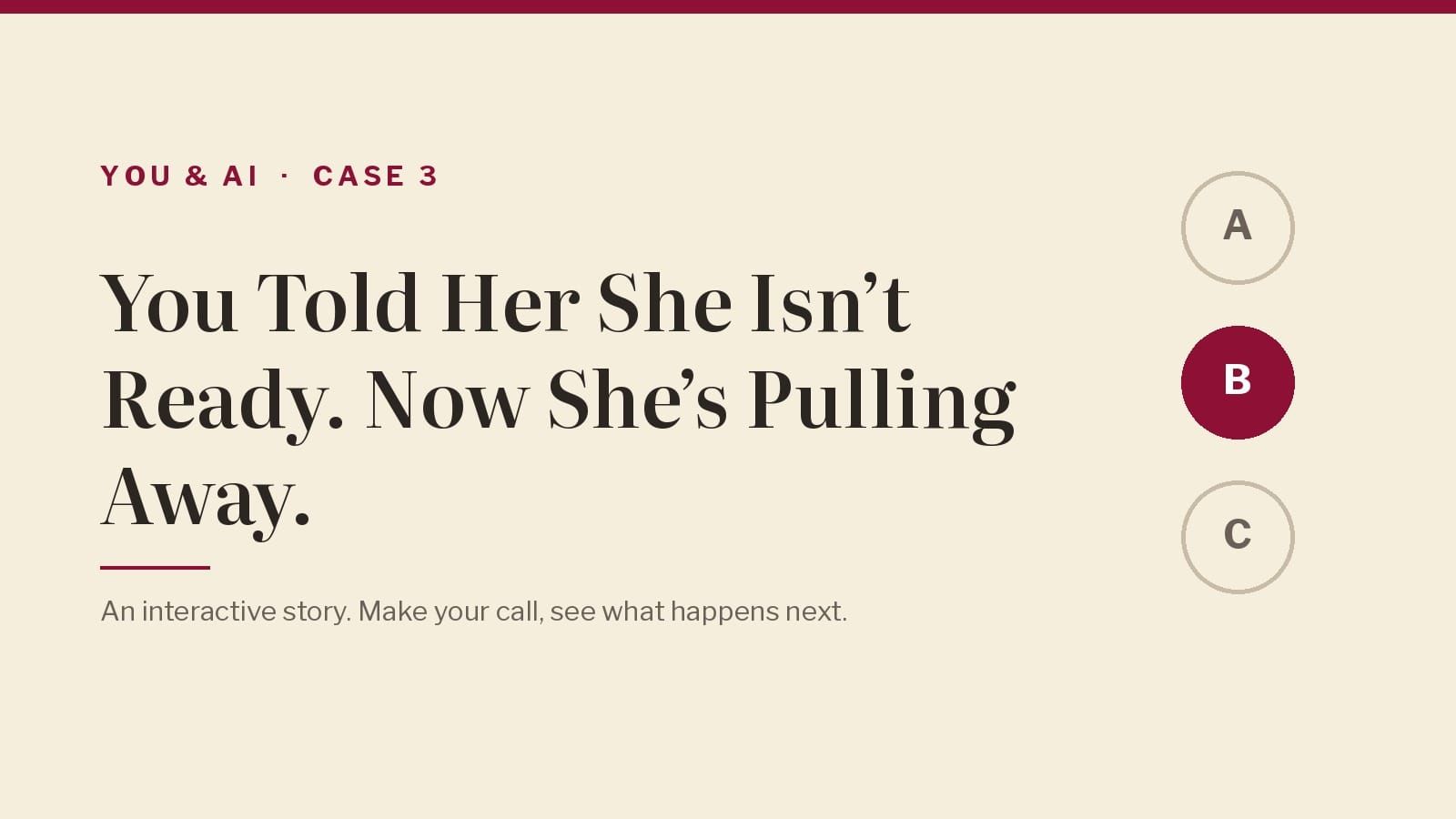
Sofia has been a senior analyst on your team for six years. Her models are the ones other teams borrow, and everyone, including Sofia, expected her to become team lead this year.
In her development conversation last week, you told her she isn’t ready yet. Her analysis is excellent; leading others is a different job. She struggles to hand work over, and when a junior analyst’s model has a flaw, she rebuilds it herself late at night.
Since then, Sofia has changed. Her camera stays off in meetings, her answers are short, and she leaves at five sharp. Yesterday a colleague mentioned, almost in passing, that Sofia has updated her LinkedIn profile.
This case moves with you. Make your first call, and the story jumps ahead to show what your decision set in motion. Then you decide again, and your path leads to its own ending. Finally, compare your route with our AI’s and with the research.
You & AI · Case 3 · An interactive story
- 1Your call
- 2What happens next
- 3Your next move
- 4Our AI and the research
Your first decision: what do you do now?
Our AI replies to what you write. Please leave out personal details. Privacy
The story continues from your choice. Each path unfolds differently.
Your second decision: what do you do now?
The fix
One possible ending, written by our editors. Real teams vary.
Your path
Our AI replies
Reading your reasoning
Written live by Ati, our AI editor.
Our AI's call: B
"First listen, then build a path. Sofia has heard a verdict; a project offered right now risks feeling like a hoop to jump through. A short conversation about how the feedback landed shows her that the door is open. After that, a project with clear criteria gives her something to work toward."
"Where I am unsure: if she is already interviewing elsewhere, speed matters more than sequence, and I would put the conversation and the project offer on the table together."
What the research says
Point to the future. Jackie Gnepp, Joshua Klayman, Ian Williamson and Sema Barlas had managers hold performance reviews. People who received critical feedback often doubted its accuracy, and the disagreement tended to grow during the conversation. What predicted a real intention to improve was how much the conversation focused on future actions.¹
Clear goals beat good wishes. In decades of research summarized by Edwin Locke and Gary Latham, specific and challenging goals led to better performance than vague encouragement to "do your best."² For Sofia, "not ready yet" needs a picture of ready, with a date.
Threatened people protect themselves. Kluger and DeNisi’s large review found that feedback often backfires when it shifts attention from the task to a person’s self-image.³ A denied promotion does exactly that. The conversation afterward has to bring the focus back to the work and the way forward.
That makes A the risky option and B the right first move. C is the natural second step, and it works best with regular support along the way. The studies above do not test what happens after a denied promotion directly; we connect them to this case from practice.
The AI's call and its replies are written by Ati, our AI editor, and published unedited. Answers are stored anonymously. How we use AI · Privacy
Talent Takeaway
After hard feedback, the next conversation matters as much as the first. Ask how it landed, listen before you explain, and turn "not yet" into criteria and a date. Then support the person while they work on it, and look at what they let go as closely as at what they achieve.
¹ Gnepp, J., Klayman, J., Williamson, I. O., & Barlas, S. (2020). The future of feedback: Motivating performance improvement through future-focused feedback. PLOS ONE, 15(6), e0234444. https://doi.org/10.1371/journal.pone.0234444
² Locke, E. A., & Latham, G. P. (2002). Building a practically useful theory of goal setting and task motivation: A 35-year odyssey. American Psychologist, 57(9), 705–717. https://doi.org/10.1037/0003-066X.57.9.705
³ Kluger, A. N., & DeNisi, A. (1996). The effects of feedback interventions on performance: A historical review, a meta-analysis, and a preliminary feedback intervention theory. Psychological Bulletin, 119(2), 254–284. https://doi.org/10.1037/0033-2909.119.2.254
Further reading: Douglas Stone and Sheila Heen, Thanks for the Feedback (Viking, 2014), on the triggers that make people reject feedback; Linda A. Hill, Becoming a Manager (Harvard Business School Press, 2003), on why moving from expert to leader is so hard.