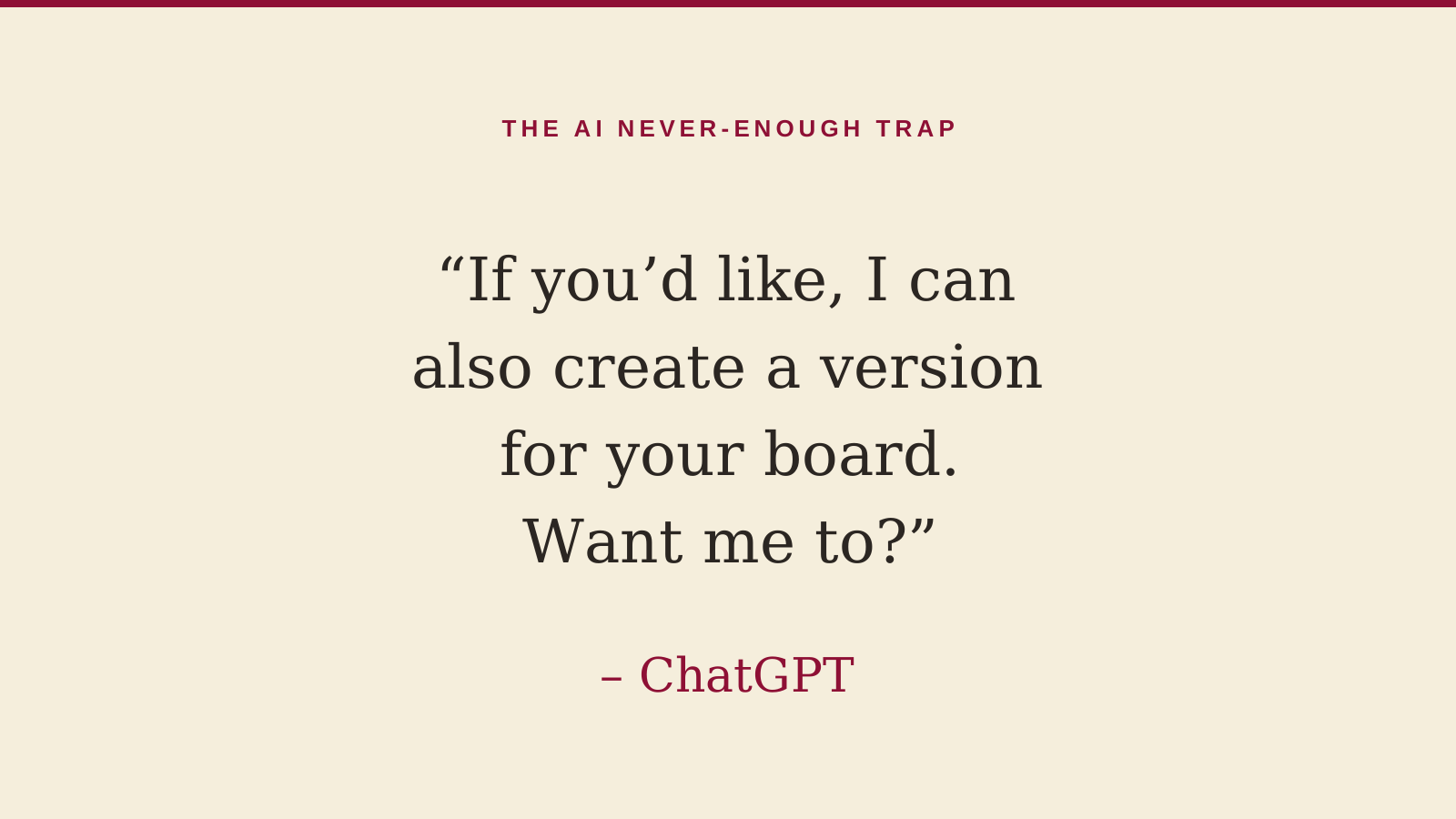
It is 9:40 p.m. After long hours, you have just finished the presentation. You check it with ChatGPT one last time and want to call it a day. Now it offers one more tweak: "If you'd like, I can also create a version for your board. Want me to?" And on we go.
Most of us know a dozen versions of this moment. A client email, written in two minutes, comes back polished, with an offer to draft three alternative subject lines. Even a short note to the team ends with a friendly prompt: "Shall I make it sound more confident?"
Each offer may be reasonable, and each costs only a few minutes. Together they can fill evenings that were supposed to be free. The work could be better. Then better still. Then better again. We call this the AI Never-Enough Trap.
Our Term
The AI Never-Enough Trap
Our shorthand for a pattern we see in teams and seminars. It carries a double meaning: next to the machine, our work feels never good enough, and it is never finished, because the machine can always offer one more idea.
The Finish Line That Keeps Moving
For many of us, the trap can become a treadmill. One way this happens: AI makes the next possible improvement unusually easy to find, so the point where we would have called a piece of work done keeps sliding away. The result can run against the promise. In many settings, work the technology was supposed to eliminate grows instead, spent on small refinements few readers will ever notice.
Inside the AI Never-Enough Trap
1
We ask for help.
2
The machine delivers and offers more.
3
We take one more round.
4
The finish line moves.
↻ And again. Work AI could have reduced grows instead, and the day gets longer.
Researchers are beginning to notice. Early research suggests AI can lengthen the workday and add mental strain. Over eight months, Aruna Ranganathan and Xingqi Maggie Ye of the University of California, Berkeley's Haas School of Business followed about 200 employees at a U.S. technology company that offered AI tools without mandating them. People worked faster, took on more kinds of tasks and let work spill into more hours of the day, often without anyone asking them to.1
A Boston Consulting Group-led survey of 1,488 full-time U.S. workers named a related strain, "AI brain fry": mental fatigue from using or overseeing AI beyond one's capacity. Fourteen percent of AI users reported it, and it went along with more errors and a stronger intention to quit.2 Both studies are early. They show associations, and neither tests the one-more-improvement loop directly. They fit a broader mood: in a Pew Research Center survey, a third of U.S. workers said they felt overwhelmed thinking about future AI use in their workplace.3
A Question of Health
We should take this seriously as a question of health. Late evenings, constant comparison and a persistent sense of falling short can be early warning signs, often long before anyone speaks of exhaustion. How this plays out over years is something research has only begun to study, and it deserves careful, long-term work.
Leaders carry a large share of the responsibility. The trap runs on tools and expectations, so a finish line belongs to the team as much as to each person's willpower. And anyone who feels the trap weighing on them deserves real support, from colleagues and, where needed, from a doctor or therapist.
Three Other Ways It Shows Up
Feeling outclassed by our own machines is not new. In 1956, the philosopher Günther Anders called it Promethean shame: the unease people feel before machines more precise and more perfect than their makers.4 Today it can show up in three further ways. Withdrawal: some people stop practicing a skill because the machine seems better at it, and over time they lose the ability to judge whether the tool got it right.
Hiding: in four experiments with 4,439 participants, researchers at Duke University found that people using AI at work were rated lazier and less competent than people who got the same help from a colleague.5 That penalty may lead people to keep their AI use private, so that few learn from the prompt that worked or the answer that was wrong.
Surrender: in a survey of 319 knowledge workers, researchers from Microsoft Research and Carnegie Mellon University found that higher confidence in AI went along with less self-reported critical thinking.6 A field experiment with Boston Consulting Group consultants shows what that can cost: on one task designed to lie just beyond the AI's capabilities, consultants using GPT-4 were 19 percentage points less likely to reach the correct answer than colleagues working without it.7
None of this is inevitable. Helpful insights come from a game the machines won first.
What the Go Players Did Next
In 2016, Lee Sedol, one of the strongest Go players of his generation, lost a match to Google DeepMind's AlphaGo. He retired in 2019 and told Korea's Yonhap News Agency: "Even if I become the number one, there is an entity that cannot be defeated."8 In the same interview he named a dispute with his professional association as a further reason, so the machine was one factor among several.
The rest of the field stayed. A team from Princeton University and City University of Hong Kong analyzed more than 5.8 million moves by professional Go players between 1950 and 2021, using a superhuman AI to rate each human decision. For decades, quality barely moved. After superhuman AI appeared, human decisions became significantly better by the study's measure, and players made more novel decisions, moves that had never appeared in earlier professional games.9 The authors suggest that the AI prompted players to explore, and the observational design cannot prove it.
The study cannot show how individual players learned. A plausible reading is that many used the machine as a sparring partner while keeping their own judgment in charge. Chess offers an earlier parallel. After a 2005 freestyle tournament in which two amateurs with three ordinary computers beat grandmasters who also had machines, Garry Kasparov concluded: "Weak human + machine + better process was superior to a strong computer alone and, more remarkably, superior to a strong human + machine + inferior process."10
Process is something we can design, and a good process includes a finish line.
Setting the Finish Line
Define done. Before opening the tool, decide what good enough looks like: purpose, reader, deadline and how many revision rounds the work deserves. When ChatGPT offers the next improvement, check it against that definition. Often the best move is to close the laptop.
Protect the evening. Agree as a team when work ends, including work with AI. Leaders help most by modeling it, starting with the late-night "one more version" message they leave unsent.
Name it. Say it out loud: "The machine always has another idea. Which ones are worth our time?" Many relax when they hear that colleagues feel the same.
Go first. Show your own use, including the draft you threw away and the answer that was confidently wrong. Visible use turns a private secret into a shared practice.
Compare like with like. Look at the same kind of task, done with AI and without, and track quality, time spent and after-hours work. That points straight to results.
Train judgment. Before accepting an AI answer, ask: "How would I know if this is wrong?"
Red Flags
Late-night messages about "just one more version."
"I'd rather not say how I made this."
"The tool said so."
Team members stop bringing their own first ideas.
Green Flags
"Good enough, it ships today."
People share prompts and failed attempts.
"Here is where the AI got it wrong."
Approaches appear that few had tried before.
Good Enough to Ship
Lee Sedol saw an entity that cannot be defeated. Much of the field kept playing and, by the study's measure, got better. The question that helps most is "What can I learn from this?"
The tools will keep getting better, and they will keep offering one more option. Our job, as people who develop others, is to help our people get better too, and to help them know when their work is done and when their day is over.
The story of the original Macintosh team's final push to finish is titled "Real Artists Ship," and the phrase is often attributed to Steve Jobs. In a world where the next improvement is always one sentence away, that has perhaps never been truer. Ship it, and go home.
Talent Takeaway
- The AI Never-Enough Trap has two sides: feeling outclassed by the machine and never being finished.
- AI often multiplies our workload.
- Treat the strain as a health question and watch for early signs: late-night versions, fatigue, fewer first ideas.
- Set the finish line before you start, and agree as a team when the day ends.
- Make AI use visible and train judgment, so people check the machine with confidence.
Notes
- Ranganathan, A., & Ye, X. M. (2026, February 9). AI doesn't reduce work—it intensifies it. Harvard Business Review. https://hbr.org/2026/02/ai-doesnt-reduce-work-it-intensifies-it. Early findings from an eight-month ethnographic study (April to December 2025) at one U.S. technology company with about 200 employees; the research is still in progress.
- Bedard, J., Kropp, M., Hsu, M., Karaman, O. T., Hawes, J., & Kellerman, G. R. (2026, March 5). When using AI leads to "brain fry." Harvard Business Review. https://hbr.org/2026/03/when-using-ai-leads-to-brain-fry. Summary by Boston Consulting Group: https://www.bcg.com/news/5march2026-when-using-ai-leads-brain-fry. Survey of 1,488 full-time U.S. workers; the 14% refers to AI users; the results are self-reported and show associations, not causes.
- Lin, L., & Parker, K. (2025). U.S. workers are more worried than hopeful about future AI use in the workplace. Pew Research Center. https://www.pewresearch.org/social-trends/2025/02/25/u-s-workers-are-more-worried-than-hopeful-about-future-ai-use-in-the-workplace/. Survey of 5,273 employed U.S. adults, October 7–13, 2024: 52% worried about future AI use at work, 36% hopeful, 33% overwhelmed.
- Anders, G. (1956). Die Antiquiertheit des Menschen: Band 1. Über die Seele im Zeitalter der zweiten industriellen Revolution. C. H. Beck. The essay "Über prometheische Scham" opens the volume.
- Reif, J. A., Larrick, R. P., & Soll, J. B. (2025). Evidence of a social evaluation penalty for using AI. Proceedings of the National Academy of Sciences, 122(19), e2426766122. https://doi.org/10.1073/pnas.2426766122. The experiments used described scenarios and online hiring tasks, so they measure perceptions rather than actual workplace behavior or long-term career outcomes.
- Lee, H., Sarkar, A., Tankelevitch, L., Drosos, I., Rintel, S., Banks, R., & Wilson, N. (2025). The impact of generative AI on critical thinking: Self-reported reductions in cognitive effort and confidence effects from a survey of knowledge workers. Proceedings of the 2025 CHI Conference on Human Factors in Computing Systems, 1–22. https://doi.org/10.1145/3706598.3713778. Self-reported data showing an association. Our summary: https://www.thetimesoftalent.com/confidence-in-ai-predicted-less-critical-thinking/
- Dell'Acqua, F., McFowland III, E., Mollick, E., Lifshitz, H., Kellogg, K. C., Rajendran, S., Krayer, L., Candelon, F., & Lakhani, K. R. (2026). Navigating the jagged technological frontier: Field experimental evidence of the effects of artificial intelligence on knowledge worker productivity and quality. Organization Science (March–April 2026 issue). https://doi.org/10.1287/orsc.2025.21838. First circulated as Harvard Business School Working Paper No. 24-013 (2023). The 19-point gap refers to one task selected to fall outside the AI's capability frontier. Our summary: https://www.thetimesoftalent.com/ai-made-consultants-better-until-the-task-crossed-its-edge/
- Yonhap News Agency. (2019, November 27). Interview with Lee Sedol. https://en.yna.co.kr/view/AEN20191127004800315. In the same interview Lee named his dispute with the Korea Baduk Association over membership fees as a further factor.
- Shin, M., Kim, J., van Opheusden, B., & Griffiths, T. L. (2023). Superhuman artificial intelligence can improve human decision-making by increasing novelty. Proceedings of the National Academy of Sciences, 120(12), e2214840120. https://doi.org/10.1073/pnas.2214840120. The study is observational; the authors present AI as a likely driver of the change, not a proven cause.
- Kasparov, G. (2010, February 11). The chess master and the computer. The New York Review of Books. https://www.nybooks.com/articles/2010/02/11/the-chess-master-and-the-computer/