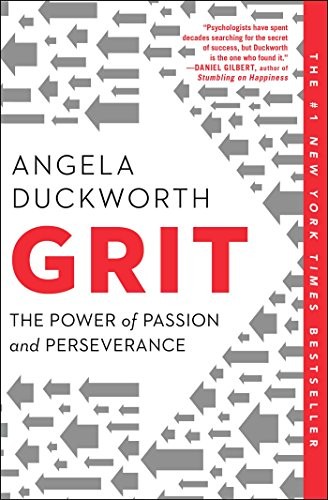
As a child, Angela Duckworth often heard from her father that she was no genius. She went on to teach middle-school math, became a psychologist at the University of Pennsylvania, and earned a MacArthur Fellowship for studying a quality she calls grit.¹ Her definition fits on a single line, and her book spends more than 300 pages on what lies behind it.
In the classroom she noticed that progress depended on more than how quickly a student picked things up. That observation became a research question: what carries people toward goals that take years?
"Perseverance and passion for long-term goals."ANGELA DUCKWORTH, 2007
What Duckworth Found
In 2007 she and three colleagues introduced a short questionnaire, the Grit Scale, and used it with adults, Ivy League undergraduates, West Point cadets and National Spelling Bee finalists.² Higher grit scores went with higher educational attainment, better grades, a greater chance that cadets completed Beast Barracks, the academy's demanding first summer, and a higher ranking at the Spelling Bee.²
A 2011 study of spelling finalists showed how this works. Grittier spellers spent more time on deliberate practice, which meant studying words alone, and that practice helped explain their stronger results. The spellers themselves rated it the most effortful and the least enjoyable way to prepare.³
Duckworth's theory of achievement counts effort twice: talent multiplied by effort gives skill, and skill multiplied by effort gives achievement.
Interest, Practice, Purpose, Hope
The middle of the book describes four assets that grit draws on. We find them a handy map for anyone who develops others.
Interest. Passion grows over time, through curiosity, exploration and the first small successes.
Practice. Following Anders Ericsson, whose book Peak sits on our shelf too, Duckworth describes deliberate practice: a stretch goal, full attention, quick feedback and time to refine.
Purpose. Interest lasts longer when the work also helps other people.
Hope. Duckworth uses the word for the belief that our efforts can improve what comes next, close to the growth mindset Carol Dweck describes in Mindset.
Growing Grit in Others
The final part of the book turns to how grit grows from the outside, and it speaks to coaches, parents and leaders alike. Duckworth points to adults who pair high standards with real warmth, to activities that are both interesting and hard, and to cultures where people share standards and feel they belong.
The Hard Thing Rule from her own family gives the idea a practical form. Each person, parents included, chooses something difficult to practice daily. Quitting waits for a natural stopping point, such as the end of a season. And each person picks their own hard thing.
Read With Care
Grit gained fans quickly, and researchers tested it hard. In 2017 Marcus Credé, Michael Tynan and Peter Harms combined 88 samples with about 67,000 people. They found a modest link between grit and performance, a strong overlap with conscientiousness, and more predictive power in the perseverance half of grit than in its consistency-of-interests half.⁴ Duckworth had reported the link with conscientiousness in 2007,² and she has described grit as a member of that family with predictive power of its own.⁵
She has also asked for restraint in how grit is used. A 2016 New York Times essay argued against grading schools on character measures such as grit.⁶ In 2019 she and colleagues followed more than 11,000 West Point cadets across a decade. Noncognitive attributes such as grit and physical ability predicted completion of initiation training and four-year graduation better than cognitive ability did, while cognitive ability best predicted academic and military grades.⁷
Whether training can raise grit scores is still debated. The habits around grit, such as deliberate practice and a clear purpose, are easy to try either way.
By the Numbers
4% of the variance in success outcomes explained by grit, on average, in the 2007 paper²
88 samples and about 67,000 people in the 2017 meta-analysis⁴
11,258 West Point cadets followed across a decade in the 2019 study⁷
Talent Takeaway
- Ask what keeps someone interested. In our next one-on-one, we can ask which part of the work they would gladly do again, and build from there.
- Agree on one stretch. Deliberate practice needs a specific goal and quick feedback, so we pick one small skill and decide together how progress will show.
- Name whom the work helps. Purpose gives effort somewhere to go, and a short sentence from us can supply it.
- Hold high standards with real warmth. The pairing Duckworth describes for parents suits coaching conversations too, and it is a hard thing in its own right. Those of us who practice it every day have good reason to be proud.
Our Take
A warm, personal case for staying with what matters. Read it for the chapters on practice and purpose, with the research that followed alongside.
¹ Duckworth, A. (2016). Grit: The power of passion and perseverance. Scribner. Get the book
² Duckworth, A. L., Peterson, C., Matthews, M. D., & Kelly, D. R. (2007). Grit: Perseverance and passion for long-term goals. Journal of Personality and Social Psychology, 92(6), 1087–1101. doi.org/10.1037/0022-3514.92.6.1087
³ Duckworth, A. L., Kirby, T. A., Tsukayama, E., Berstein, H., & Ericsson, K. A. (2011). Deliberate practice spells success: Why grittier competitors triumph at the National Spelling Bee. Social Psychological and Personality Science, 2(2), 174–181.
⁴ Credé, M., Tynan, M. C., & Harms, P. D. (2017). Much ado about grit: A meta-analytic synthesis of the grit literature. Journal of Personality and Social Psychology, 113(3), 492–511. doi.org/10.1037/pspp0000102
⁵ Kamenetz, A. (2016, May 25). MacArthur "genius" Angela Duckworth responds to a new critique of grit. NPR. npr.org/transcripts/479172868
⁶ Duckworth, A. (2016, March 26). Don't grade schools on grit. The New York Times.
⁷ Duckworth, A. L., Quirk, A., Gallop, R., Hoyle, R. H., Kelly, D. R., & Matthews, M. D. (2019). Cognitive and noncognitive predictors of success. Proceedings of the National Academy of Sciences, 116(47), 23499–23504. doi.org/10.1073/pnas.1910510116