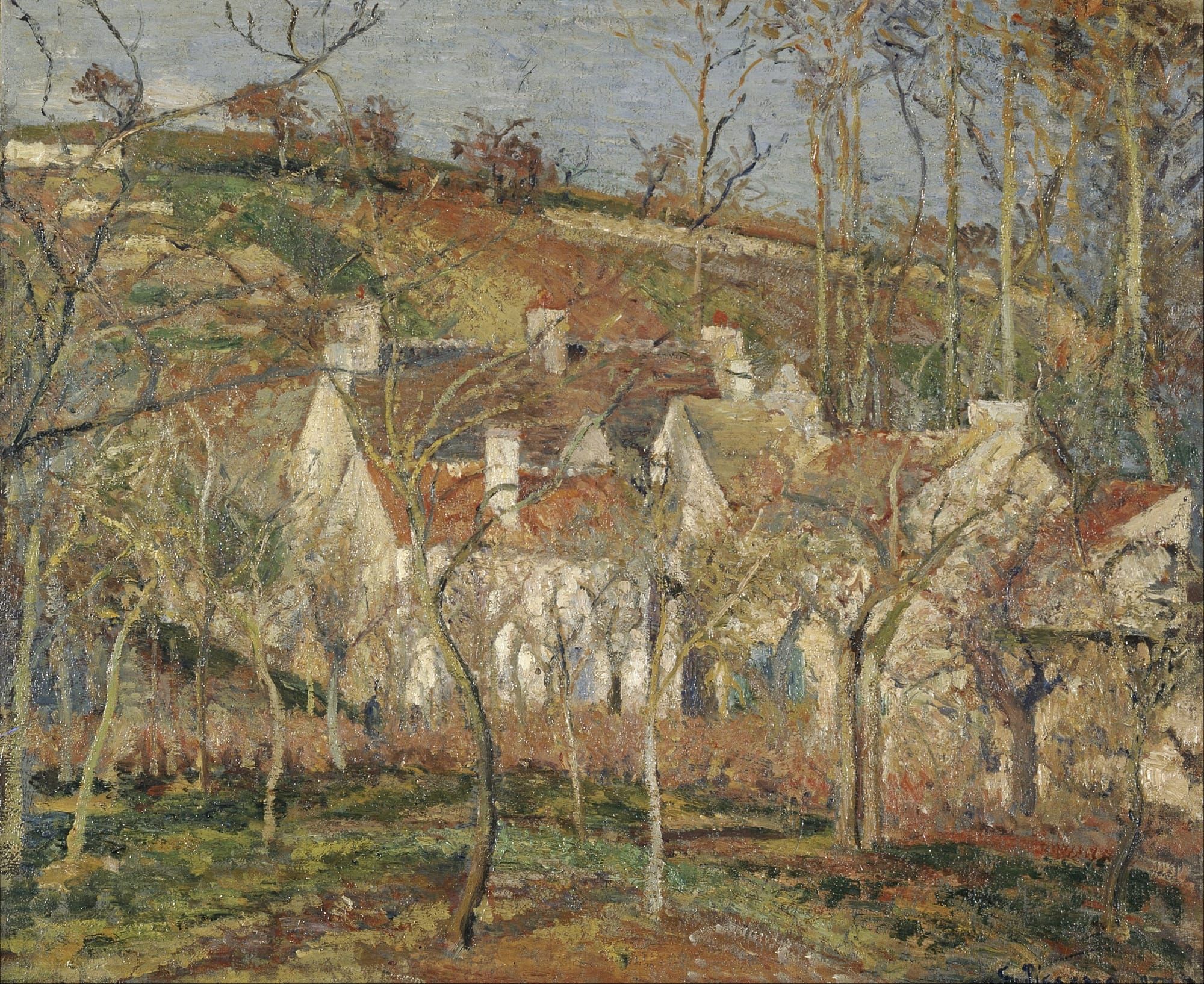
Camille Pissarro (1830–1903) is often called the father of Impressionism. He was the only painter to show work at all eight of the group's exhibitions, from 1874 to 1886, and the circle of artists who learned from him reads like a table of contents of modern art: Cézanne, Gauguin, Seurat, Signac, Cassatt, and his own sons.¹ His paintings hang in the great museums. His longer-lasting work may be the careers he shaped. It starts on a hillside.
Pontoise, a small town on the Oise, northwest of Paris, around 1877. Two easels stand on the same slope, the Côte des Bœufs. Two men paint the same houses, the same trees, the same winter light.
The older one is in his mid-forties, bearded, patient, known among his friends as the calmest head in a quarrelsome group of painters. The younger one is in his late thirties, moody, and a favorite target of the Paris critics, who find his pictures crude and clumsy.
Put the two canvases side by side today and you see two handwritings. The older man builds the hill from soft, feathery touches. The younger one lays it down in blocks, almost like masonry. Nobody tells the other how to paint. They simply work next to each other, day after day.
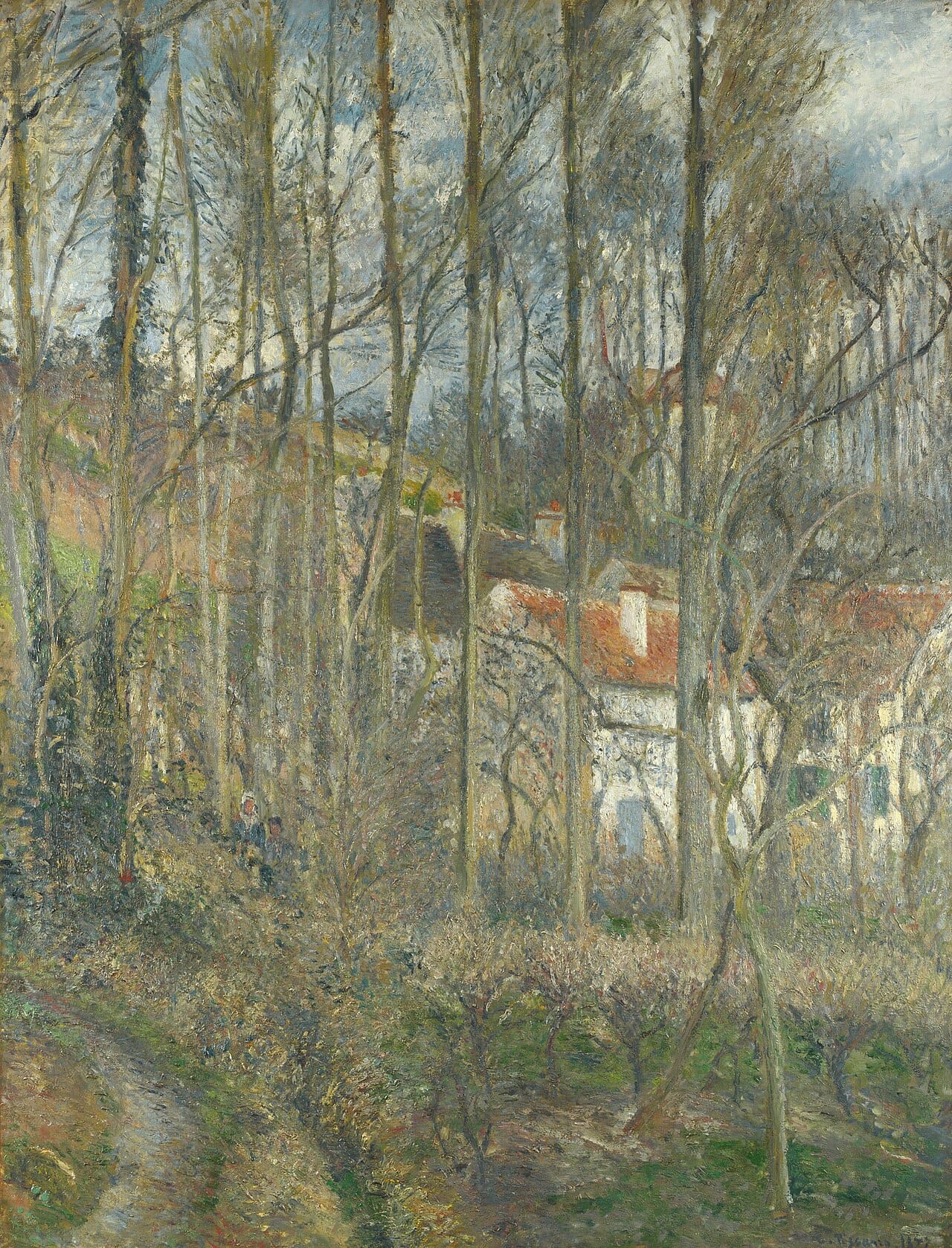
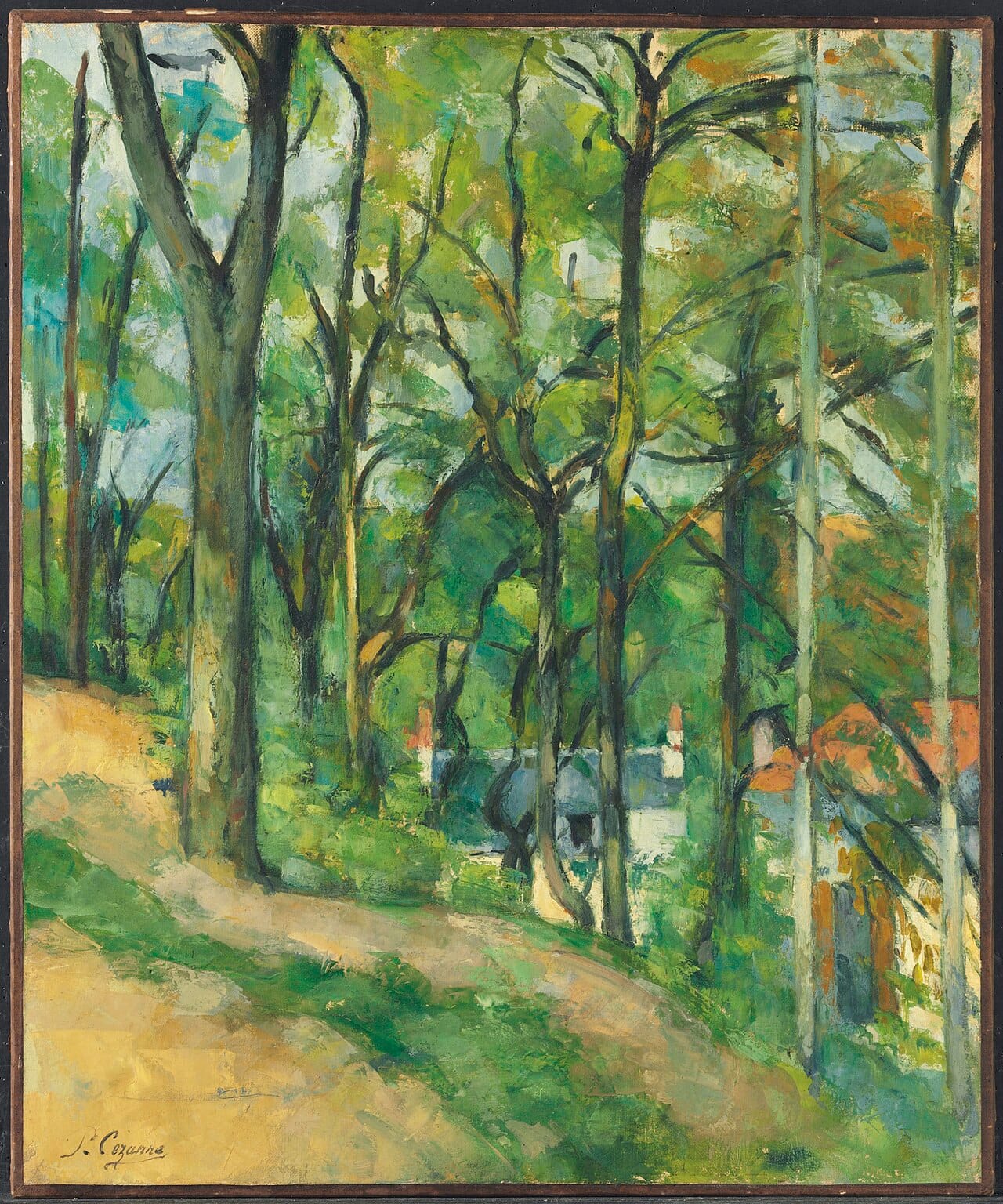
The younger man is Paul Cézanne, soon to be called the father of modern painting. The older one is Pissarro. Almost thirty years later, when Cézanne was famous and Pissarro was dead, Cézanne asked to be listed in an exhibition catalogue in Aix as "Paul Cézanne, pupil of Pissarro."²
A Teacher Without a School
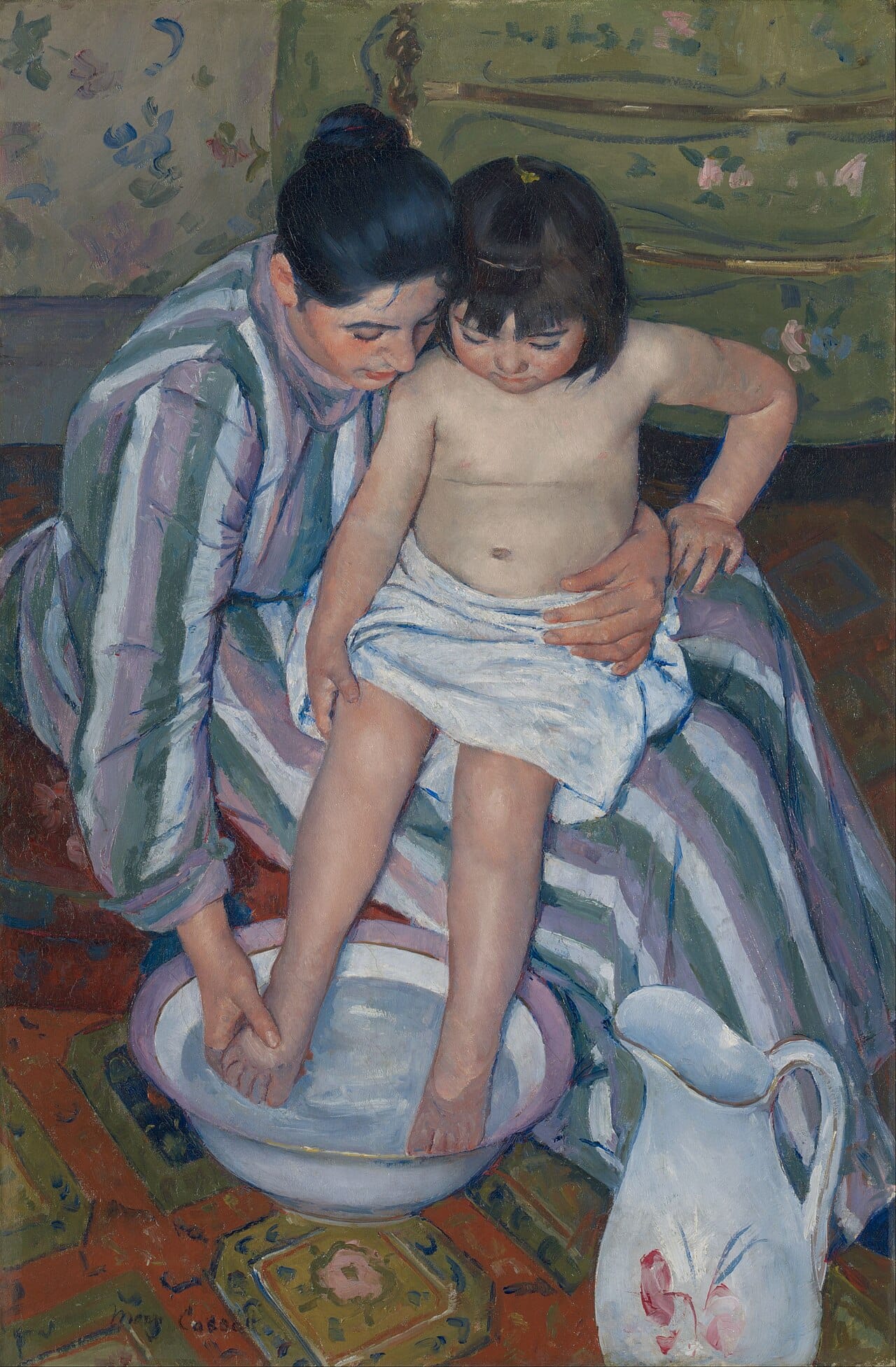
Pissarro never ran an academy. He had no paying students, no curriculum, no certificates. Yet the painters who learned from him include Cézanne, Gauguin, Seurat, Signac, Mary Cassatt, and in his final years a young Henri Matisse, who came to ask for advice.³
Cassatt, the story goes, once said he was such a teacher "that he could have taught the stones to draw correctly."⁴
So what did he do that the academies of his time did not? Looking at his relationships one by one gives us a surprisingly practical answer.
The One Everyone Laughed At
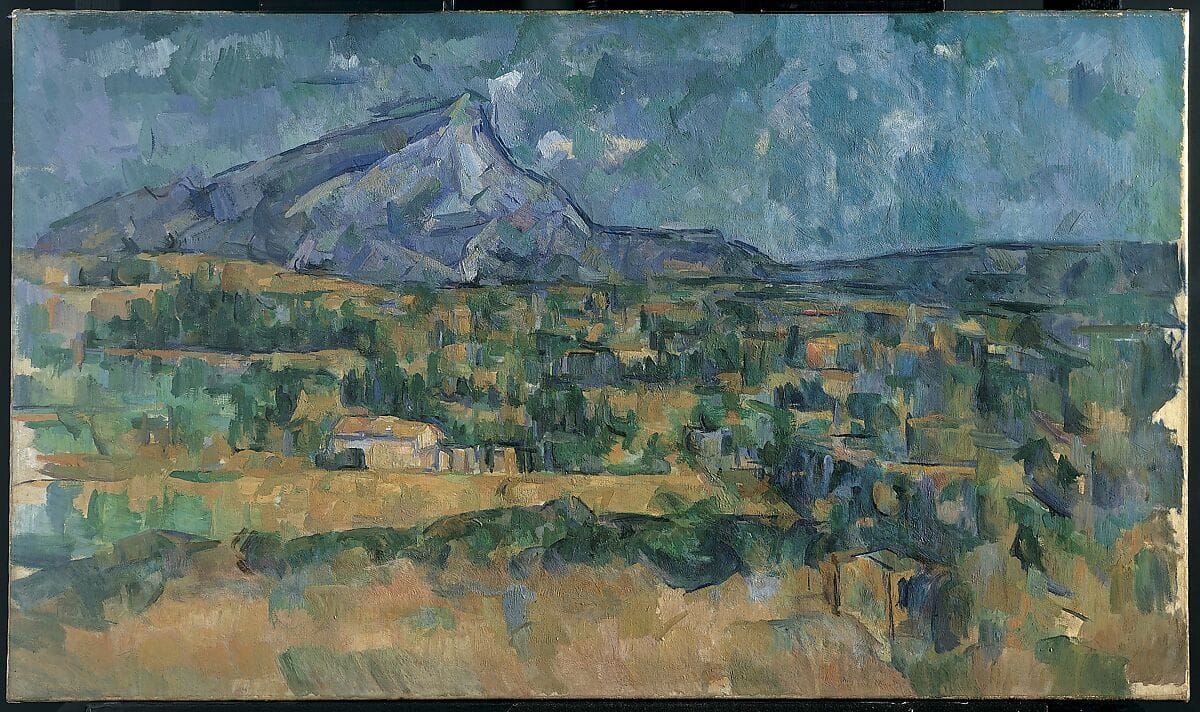
When Cézanne came to Pontoise in 1872, he had little to show for a decade of work. His early paintings were dark, violent, and rejected by the official Salon year after year.
Pissarro did three things. He took him outdoors and had him study nature slowly, patch by patch. He let him copy one of his own landscapes, a view of Louveciennes, so Cézanne could feel from the inside how the older painter built a picture.⁵ And he defended him in public, long before the market did.
Cézanne's palette brightened. His brushwork found its structure. The rest is art history.
What we can take from it
The people who need us most often look least promising at first sight. Standing by them early is part of the job.
The Stockbroker Who Wanted to Paint
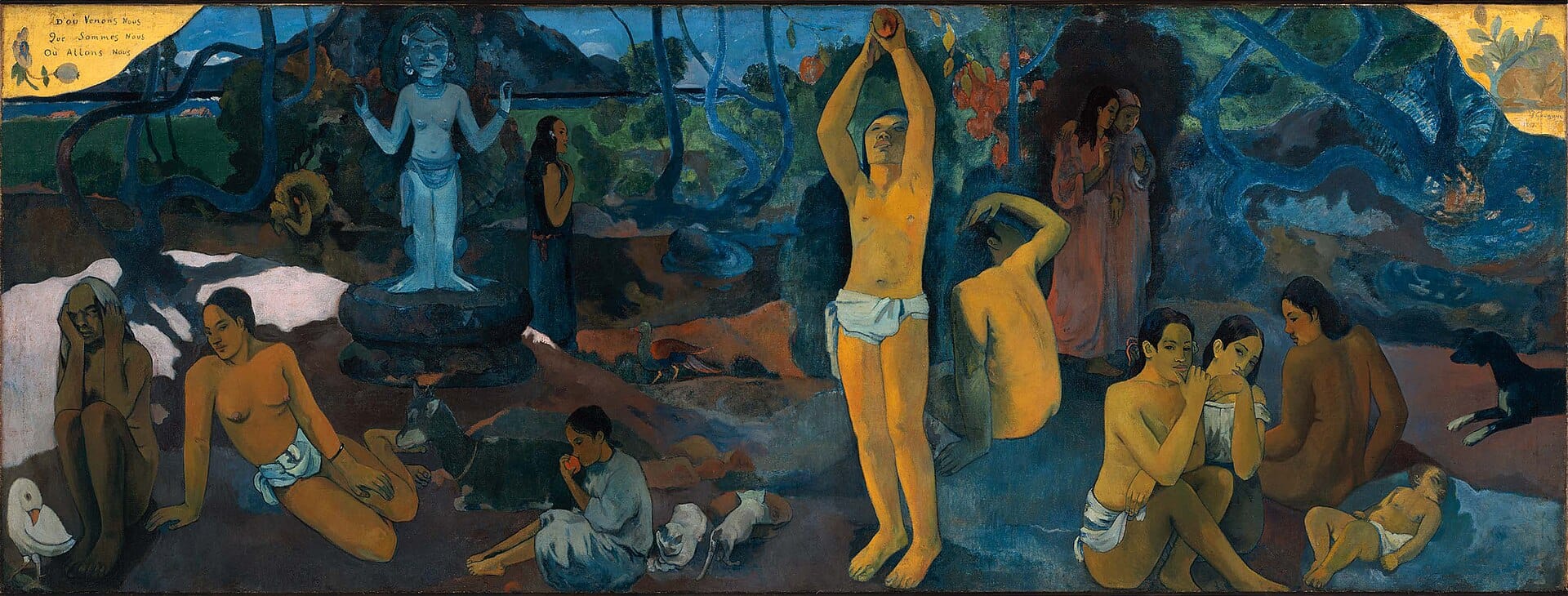
Paul Gauguin was a successful man in Paris finance when he began buying Impressionist paintings, Pissarro's among them. Then he wanted to paint himself. Pissarro took the amateur seriously, invited him to Pontoise, and painted alongside him for several summers.
Gauguin later went his own way, to Brittany, to Tahiti, to a style that had little in common with his mentor's. Yet near the end of his life he wrote about Pissarro: "He was one of my masters and I do not deny him."⁶
A sheet in the Musée d'Orsay captures the relationship in a single image: Gauguin drew Pissarro, and Pissarro drew Gauguin, on the same page.⁷
What we can take from it
Talent often sits in the wrong job. A mentor sees what someone could become, and treats them as a colleague from day one.
Learning From the Young
In 1885, at the age of 55, Pissarro did something few established artists dare. He met Georges Seurat and Paul Signac, both in their twenties, and adopted their new technique of painting in small dots of pure color. He even insisted that the two young painters be included in the final Impressionist exhibition of 1886, against the resistance of older colleagues.⁸
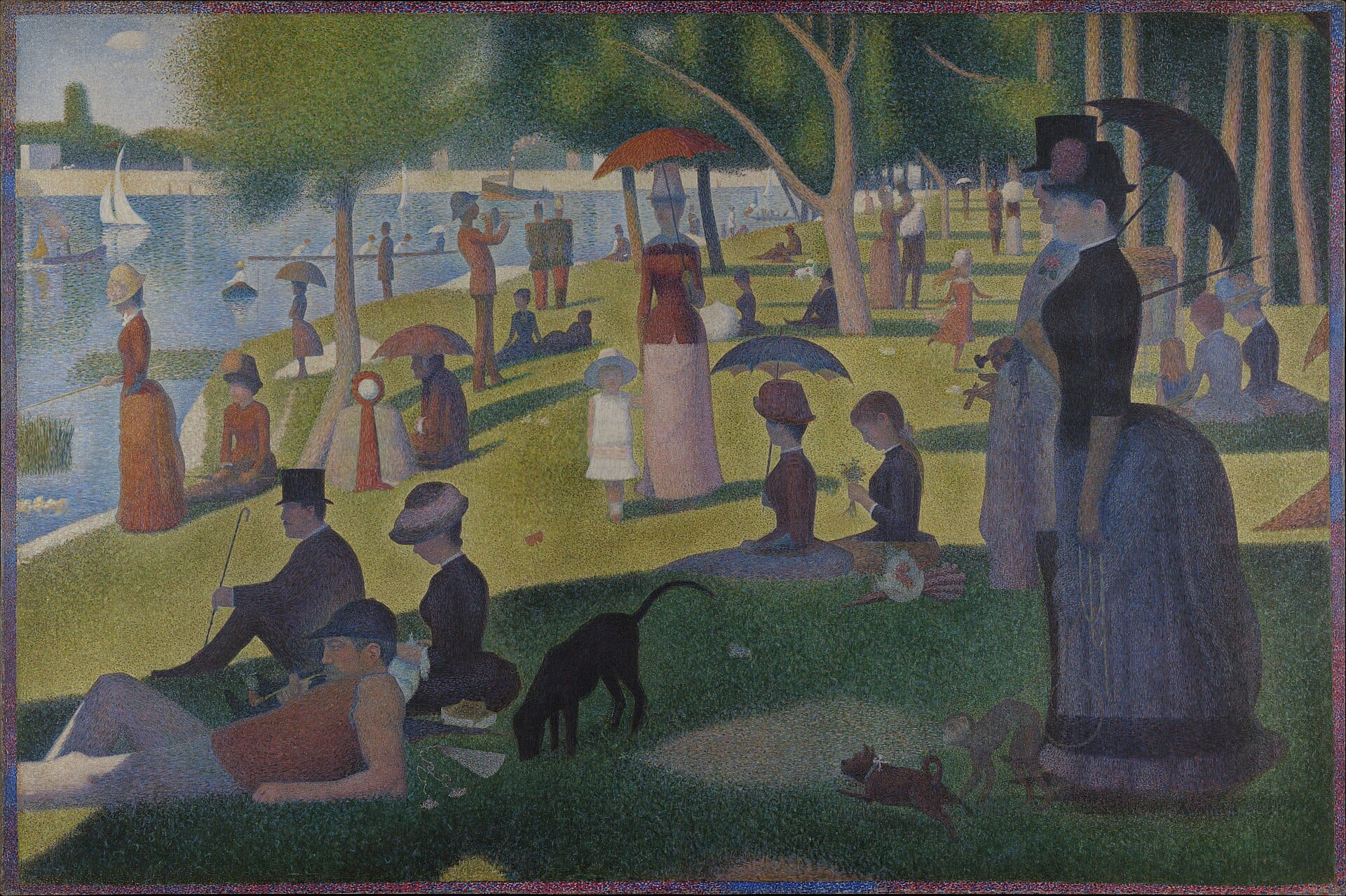
A few years later he set the technique aside. It made it impossible, he explained, to stay true to his sensations and to give his drawing an individual character.⁹ He had tried it seriously, learned what he needed, and moved on.
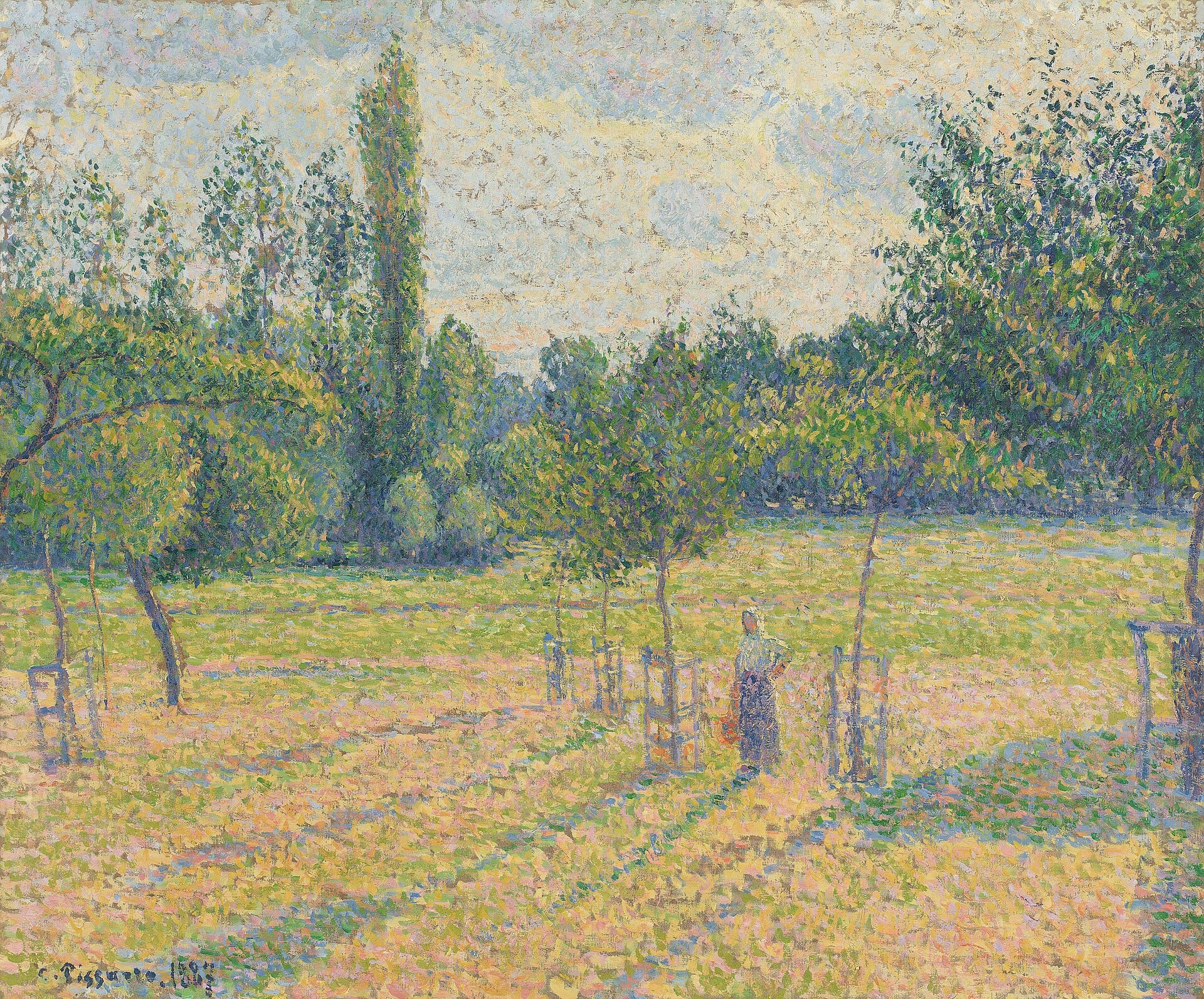
The learning also ran in the other direction with Cézanne. In a letter to his son Lucien in 1895, Pissarro noted that Cézanne had been influenced by him in Pontoise, and he by Cézanne.¹⁰
What we can take from it
Good mentors stay students. They try what the young bring in, and they say openly what they learned from them.
A Family of Painters
The first pupils Pissarro had were his own children. He taught them at home and took them along to paint, and five of his sons became artists: Lucien, Georges Manzana, Félix, Ludovic-Rodolphe, and Paul-Émile.¹¹
The longest mentoring relationship of his life was with Lucien, the eldest, who moved to London and became a wood engraver and book designer. For two decades the father wrote to him regularly, about color, about composition, about money, doubt, and exhibitions. The letters fill a book.¹²
They read like coaching sessions on paper: honest about weaknesses, generous with encouragement, and always pointing the son back to his own eye.
What we can take from it
Development continues across distance. A regular, personal note can carry a surprising amount of learning.
A Mentor on the Record
Few teachers in art history left as much behind about how they taught. Pissarro's correspondence, edited by Janine Bailly-Herzberg, fills five volumes.¹³ His pupils wrote down his advice, and Cézanne and Gauguin both put their debt to him in writing.
Scholars have mined this record for decades. John Rewald, who edited the letters to Lucien, placed Pissarro at the center of his classic The History of Impressionism. Richard Brettell's Pissarro and Pontoise reconstructs the landscape where so much of the teaching happened.¹⁴ In 2005, the Museum of Modern Art hung the two painters' pictures side by side in Pioneering Modern Painting: Cézanne & Pissarro 1865–1885, curated by his great-grandson, Joachim Pissarro. In 2022, the Ashmolean Museum in Oxford titled its exhibition simply Pissarro: Father of Impressionism.
Why It Worked
The writer Daniel Coyle calls places like Pontoise "talent hotbeds," small clusters where an unusual number of talents emerge at the same time.¹⁵ Sydney Finkelstein describes the leaders behind such clusters as "superbosses," people whose former protégés go on to lead their fields.¹⁶ Pissarro fits both patterns closely: he spotted unusual talent, adapted to each person, worked alongside them, and stayed connected long after they left.
Research on mentoring adds two points that help us today.
First, mentors gain too. A meta-analysis by Rajashi Ghosh and Thomas Reio found that people who mentor others report higher job satisfaction and stronger commitment to their organization than those who do not.¹⁷ Pissarro's own life, and his experiments at 55, look like a case study.
Second, similarity is a trap. A large meta-analysis led by Lillian Eby found that protégés rate their mentoring relationships most positively when they feel similar to their mentors in attitudes, values, and personality.¹⁸ That is comfortable for both sides. Pissarro did the opposite. Cézanne, Gauguin, Seurat, and Cassatt painted in ways that had little in common with his own work, and he helped each of them find their own.
What Pissarro Did
He worked side by side. Same hill, same light, two easels. People learned by watching him work, and he watched them.
He bet early. He stood by Cézanne while the critics laughed and long before the market caught up.
He took outsiders seriously. A stockbroker, an American woman in Paris, his own children: he treated each of them as a colleague.
He stayed a student. At 55 he learned a new technique from painters half his age, and said so.
He helped people become themselves. None of his pupils paints like him. Each of them paints like no one else.
Be Bold
In the 1890s, a young painter named Louis Le Bail asked Pissarro for advice. He wrote the answers down. Among them: "Don't proceed according to rules and principles, but paint what you observe and feel." And: "One must be bold, at the risk of being deceived and making mistakes."¹⁹
It is advice for painters. It works just as well for anyone who develops others: give people room, trust what they see, and let them risk a mistake.
Pissarro left behind hundreds of paintings. His longer legacy walks through the museums under other names. He can be a master for all of us.
Talent Takeaway
Pissarro developed people by working next to them, taking them seriously before anyone else did, and learning from them in return. For our own teams, that means three things:
Spot talent early. Look for it in unlikely places, before the market sees it.
Back difference. Help people who work differently from us find their own way.
Keep learning. Ask what the people we develop can teach us.
¹ Ashmolean Museum. (2022). Pissarro: Father of Impressionism [Exhibition]. Oxford. On the eight exhibitions: Rewald, J. (1973). The history of Impressionism (4th rev. ed.). Museum of Modern Art.
² Rewald, J. (1989). Camille Pissarro. Harry N. Abrams, p. 45. See also Pissarro, J. (2005). Pioneering modern painting: Cézanne & Pissarro 1865–1885. Museum of Modern Art.
³ Art Gallery of New South Wales. Camille Pissarro (collection biography).
⁴ Attributed to Mary Cassatt and widely quoted in accounts of Pissarro's life, e.g., The great masters (2004). Quantum Books, pp. 279–319.
⁵ Pissarro, J. (2005). Pioneering modern painting: Cézanne & Pissarro 1865–1885. Museum of Modern Art.
⁶ Gauguin, P. (1902). Racontars de rapin. Quoted in Rewald, J. (1989). Camille Pissarro. Harry N. Abrams, p. 45.
⁷ Paul Gauguin and Camille Pissarro, Portrait of Pissarro by Gauguin; Portrait of Gauguin by Pissarro, c. 1880. Musée d'Orsay, Paris (Département des Arts graphiques du Musée du Louvre).
⁸ Rewald, J. (1973). The history of Impressionism.
⁹ Pissarro, C. (1896). Letter to Henry van de Velde, 27 March 1896. Quoted in Rewald, J. (1989). Camille Pissarro. Harry N. Abrams, p. 41.
¹⁰ Pissarro, C. (1943). Letters to his son Lucien (J. Rewald, Ed.). Pantheon. Letter of 22 November 1895.
¹¹ Shikes, R. E., & Harper, P. (1980). Pissarro: His life and work. Horizon Press.
¹² Pissarro, C. (1943). Letters to his son Lucien (J. Rewald, Ed.). Pantheon.
¹³ Bailly-Herzberg, J. (Ed.). (1980–1991). Correspondance de Camille Pissarro (Vols. 1–5). Presses Universitaires de France; Éditions du Valhermeil.
¹⁴ Brettell, R. R. (1990). Pissarro and Pontoise: The painter in a landscape. Yale University Press.
¹⁵ Coyle, D. (2009). The talent code. Bantam.
¹⁶ Finkelstein, S. (2016). Superbosses: How exceptional leaders master the flow of talent. Portfolio.
¹⁷ Ghosh, R., & Reio, T. G., Jr. (2013). Career benefits associated with mentoring for mentors: A meta-analysis. Journal of Vocational Behavior, 83(1), 106–116. https://doi.org/10.1016/j.jvb.2013.03.011
¹⁸ Eby, L. T., Allen, T. D., et al. (2013). An interdisciplinary meta-analysis of the potential antecedents, correlates, and consequences of protégé perceptions of mentoring. Psychological Bulletin, 139(2), 441–476. https://doi.org/10.1037/a0029279
¹⁹ Louis Le Bail's notes of Pissarro's advice, quoted in Rewald, J. (1973). The history of Impressionism.
Further reading: Irving Stone, Depths of Glory: A Biographical Novel of Camille Pissarro (Doubleday, 1985); John Rewald, The History of Impressionism (Museum of Modern Art, 1973); John Rewald, Camille Pissarro (Harry N. Abrams, 1989); Joachim Pissarro, Pioneering Modern Painting: Cézanne & Pissarro 1865–1885 (Museum of Modern Art, 2005); Richard R. Brettell, Pissarro and Pontoise (Yale University Press, 1990).
Images: Wikimedia Commons and The Metropolitan Museum of Art (Open Access), public domain.