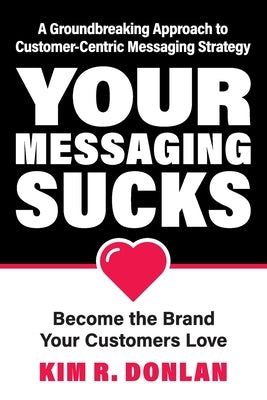
A book that tells you on the cover that your messaging sucks has our attention. Your Messaging Sucks by Kim R. Donlan then does something friendly with that opening: it hands you a method for being understood.¹
Donlan wrote it for marketers, founders and agency leaders, and anyone in that world will find a book full of wisdom, experience and best practices.² The interesting part is how much it offers beyond that circle. Those of us who develop talent will find plenty to borrow, because the question underneath is ours too: what does the person on the other side hear, compared with what we meant to say?
"Like people, brands want to be heard."KIM DONLAN³
A Media Psychologist in the Boardroom
Kim Donlan holds a master's degree in media psychology from William James College and a business degree from Northeastern University. She is CEO of RedSwan5, a Boston agency, and a lecturer in marketing at Boston University's Questrom School of Business, where she teaches branding, digital marketing, new product development and more.⁴ She served as chief marketing officer for five venture-backed tech start-ups, joining at early stages and pivot points when a new market had to be found.⁵ She shaped the messaging and positioning for ten of Boston's leading tech and consumer IPOs.⁶
What stands out for us is the teaching thread. Donlan has built branding, digital marketing and customer experience courses, and she describes the aim of her book as giving the people who shape a brand experience a process they can learn and apply.⁷ That makes her a talent developer in her own right. She also sees personal and corporate branding as closely linked,⁸ a useful idea for every coach, speaker and leader who builds a name on purpose.
What the Book Offers
The starting point is a gap. What we think we offer and what our audience believes we offer can drift apart, and Donlan calls that gap a messaging problem.⁹ It is easy to miss, because it first looks like an execution issue. When prospects hesitate, teams look at leads, product and user experience, and finally at one another. Donlan looks at the process. Messaging tends to come last, after research, strategy and campaigns, and her answer is to bring the customer's viewpoint in at the start.¹⁰
Her method blends design thinking, improv, media psychology, emotional consumer behavior, user experience design and consumer insights, refined over more than 30 years.¹¹ The book turns it into step-by-step guidance and workshops.¹² It speaks to seven situations, among them a sales process that feels slow and confusing, marketing programs that stall, and a value proposition that few people truly understand.¹³
The Book at a Glance
Your Messaging Sucks: Become the Brand Your Customers Love
Kim R. Donlan, RedSwan5, February 2023
242 pages, paperback¹⁴
Language: English
Five Ideas for People Who Develop Others
Donlan writes about brands. Swap "customer" for "participant," "client" or "team member," and her ideas travel well.
Start with their view. Donlan wants messaging to match the audience's own words, emotions and mindset.¹⁵ A program description, a feedback talk or an invitation to a workshop gets stronger when we first ask how it sounds from the other chair.
Ask early. She observes that messaging tends to arrive at the end of the marketing process. Talent work offers the same chance: speak with participants before we design, and again as we go.
Look at the process. When results fall short, Donlan notes, we tend to point at people: the marketer, the salesperson, the agency. Her habit is to examine the process first. In a learning program, that habit protects participants and keeps the redesign moving.
Bring the people in the room. For Donlan, the insights, experiences and willingness to listen of the people in the room shape the message that emerges. The same holds for a program. A facilitator's presence is part of its design.
Learn by doing. Workshops sit inside the book, each built to give individuals, teams and companies breakthrough insights and progress. A good reminder that a method becomes ours once we practice it together.
A blunt title, a generous author and a method built on listening: for anyone who helps others grow, and for anyone who wants a message to land, this book is worth keeping within reach.
Talent Takeaway
- You who develop others already ask what people need. Donlan gives that instinct a method.
- Look at your offer through the participant's eyes before you describe it.
- Invite their view early, and keep asking as the program grows.
- When results fall short, review the design first.
- Practice new methods in a workshop with colleagues.
¹ Donlan, K. R. (2023). Your messaging sucks: Become the brand your customers love: A groundbreaking approach to customer-centric messaging strategy. RedSwan5. ISBN 9798986653013. https://pastforward.org/products/your-messaging-sucks-9798986653013
² Ibid.
³ Donlan, K. (n.d.). A better approach to customer-centric messaging and engagement: Insights Book Club Q&A with Kim Donlan. Insights@Questrom, Boston University. https://insights.bu.edu/your-message-sucks/
⁴ Boston University Questrom School of Business. Kim Donlan, Lecturer in Marketing. https://www.bu.edu/questrom/profile/kim-donlan/. See also the biography on Coursalytics: https://coursalytics.com/experts/kim-donlan
⁵ Donlan, Insights Book Club Q&A (see note 3).
⁶ Podcast episode description, Kim Donlan (episode 178). Buzzsprout. https://feeds.buzzsprout.com/1155908/14417407-s18-e178-kim-donlan
⁷ Donlan, Insights Book Club Q&A (see note 3).
⁸ Ibid.
⁹ Donlan, Your messaging sucks (see note 1).
¹⁰ Donlan, Insights Book Club Q&A (see note 3).
¹¹ Ibid.
¹² Donlan, Your messaging sucks (see note 1).
¹³ Ibid.
¹⁴ Ibid.
¹⁵ Donlan, Insights Book Club Q&A (see note 3). The four ideas that follow draw on the same interview.