Your most experienced engineer walks the team through the new approval process. The explanation is clear, correct and complete. Twelve heads nod. A week later nothing has changed, and three people have quietly asked the intern how it actually works.
Familiar? Most of us have sat in that meeting, and some of us have given the presentation.
The question
How do we make sure the whole team knows what our best people know?
This question has rarely been as important as it is today. Luckily, it is an old question. Quite a few true masterminds have tackled it before us, and I believe there is a lot to take from them: today, perhaps even more than ever.
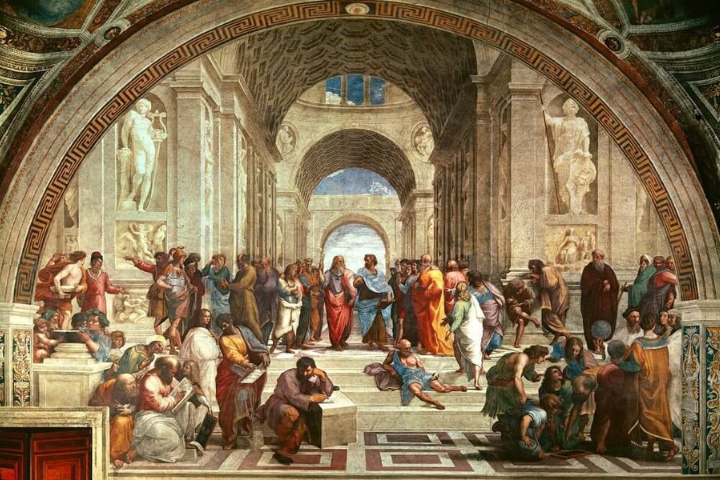
One of them put his answer in paint. Raffaello Sanzio (1483–1520), or Raphael for short, one of the great artists of the Renaissance, painted it into one of the most famous frescoes in the world, The School of Athens. Whether he meant it as an answer to our question, we cannot ask him. I think he would have liked it.
What should we do? Buy a leadership book?
Let's look closer first.
Rome, 1509
A young painter from Urbino, still in his mid-twenties, gets a wall in the private apartments of Pope Julius II. Within about two years, Raphael fills it with ancient philosophy. Plato, Aristotle, Socrates, Pythagoras, Euclid and dozens more, all gathered in a grand hall that never existed. No pressure, then.¹
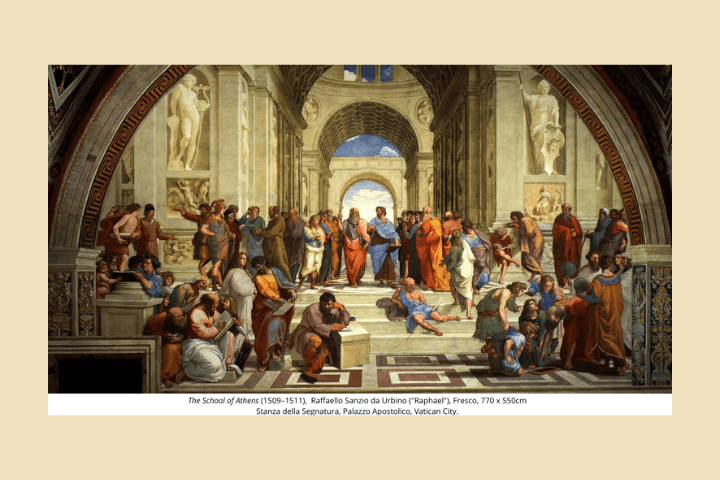
Guidebooks sell The School of Athens as a who's who of Western thought. But here's another interesting perspective: why not look at it as a gallery of people who learn and teach in very different ways? Plato points to the heavens, Aristotle to the world in front of him. Socrates counts off his arguments on his fingers and asks questions. Pythagoras writes while others lean in to copy. Heraclitus sits alone with his thoughts. In the first two parts of this series we looked at these types (part one on Plato, Aristotle and Socrates, part two on the rest of the cast).
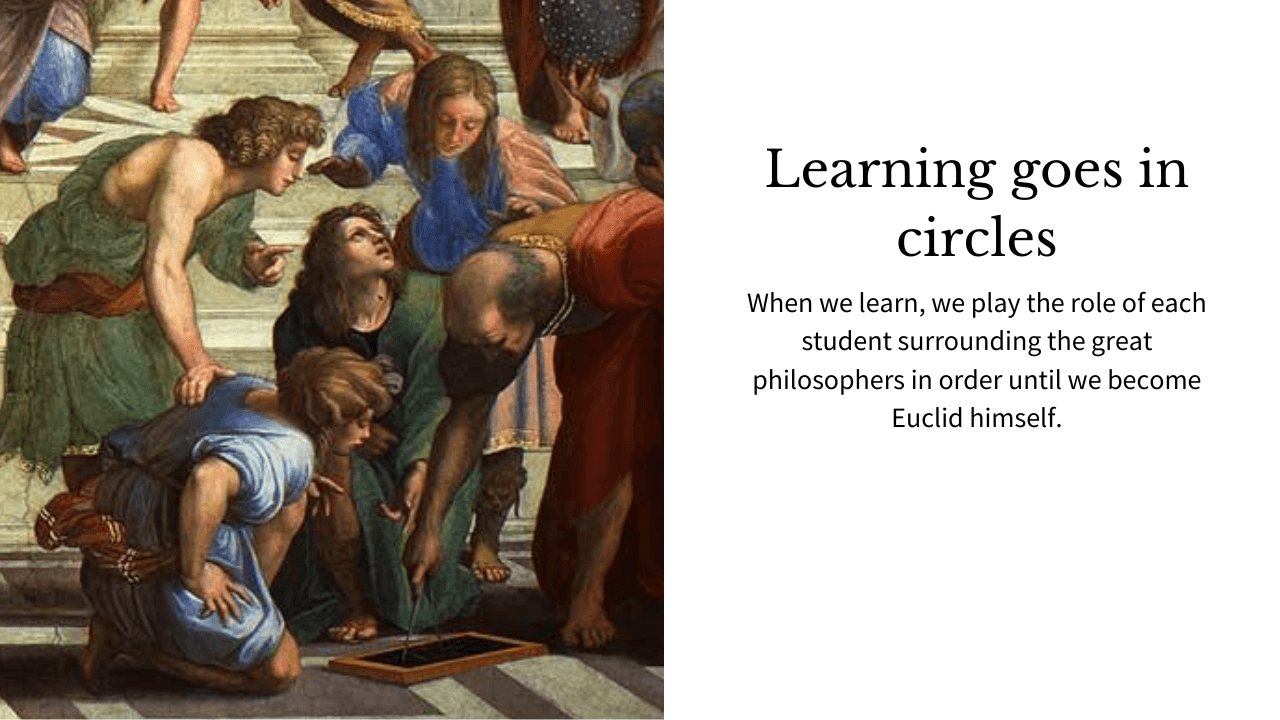
For our question, one group is especially worthwhile: the one on the bottom right. Euclid bends low over a slate with a pair of compasses and works through a proof.²
A word about the man with the compasses. Euclid taught in Alexandria around 300 BC and wrote the Elements, a geometry textbook that builds everything from a few simple assumptions, one careful step at a time. It remained a standard textbook for some two thousand years, which makes it one of the most influential teaching books ever written. Euclid is also said to have told King Ptolemy that there is no royal road to geometry.³ Even kings begin on the floor.
Four students crowd around him, and from the bottom up we can read a chain. At the bottom, a student kneels and studies the slate. He has not cracked it yet. Right next to him, a classmate looks up in amazement: something just clicked, and he is not sure what. Above them, a third leans in, puts a hand on a shoulder and seems to begin explaining. At the very top, a fourth bends in with an open hand and takes in the whole scene. And Euclid? He shows the proof and keeps his eyes on his compasses. He does not even look up.
We admit, this is our reading. Raphael left no instruction manual. But it is a reading with a lot of workplace in it: your team meeting, painted in 1511, with better lighting.
Four students, four answers
Look at the four again. Each stands at a different step, and each would need a different answer from us.
- The student on the floor needs time and a concrete example. A longer lecture will pass right over him.
- The amazed classmate needs a good question, so the "aha" turns into understanding.
- The one with the hand on the shoulder needs a stage and a thank-you. Let him explain, and say so out loud.
- The one at the top with the open hand needs the big picture: why this proof matters and where it leads. Once he sees the whole building, he will find his own way in.
Euclid keeps his eyes on the compasses. How much each student has understood, the picture leaves open. For those of us explaining something at work, and especially for the experts among us, who occasionally might forget the room while a good proof is on the slate, that is a good moment to lift our heads and see where the others stand (or sit).
Now think of the meeting from the start. One briefing, one presentation, one answer for all twelve. It fits the person who is ready for it, and passes the others by. The right answer depends on where someone stands.
Six moves to use immediately
- Find out where people stand. Before anyone explains, ask everyone to mark where they stand, privately or by a show of hands: new to this, ready to try it, or ready to explain it? Thirty seconds, and you know which answer each person needs.
- Let the person one step ahead explain first. Choose someone who learned the process last week. They often still remember where it gets confusing, and that is what the room needs.
- Then ask the expert to add the rest. Depth, corrections, the hard questions. The room gets the full picture, and the expert gets to complete it.
- Skip "Any questions?" It is a reliable way to get silence. Ask instead: "Who can tell us in two minutes what we just decided?" Then ask a second person to add what the first one skipped.
- Look for the person on the floor. New hires, career changers, the colleague who nodded politely. Confusion rarely announces itself, so name one person who looks after each of them.
- Give the explainer credit. Explaining a topic to others often deepens our own understanding, which is why we have a glossary entry on the Protégé Effect. So the explainer gains too, and the whole room sees whom to ask next time.
Raphael practiced what he painted
Raphael painted his own circle into the picture, too. According to a long tradition, Plato has the face of Leonardo da Vinci, the older master Raphael studied closely.⁴ Giorgio Vasari, writing in 1550, says the stooping figure with the compasses is a portrait of the architect Donato Bramante, who, according to Vasari, recommended Raphael to the pope. Today the figure is usually read as Euclid, with Bramante's features as a possibility.⁵ Role model and sponsor, both in the picture. Smart, and rather kind. Leonardo, by the way, believed in learning from others himself: see Excellence Is a Team Sport.
How did Raphael run his own shop? Vasari knew several of his former assistants and describes a workshop that ran on courtesy: bad feelings seemed to vanish around him. He adds that when Raphael went to court, some fifty painters walked out of his house with him.⁵ Fifty! Many of us would be happy with a team meeting where most people turn up on time. Vasari loved a good story, so let's allow for generosity in the numbers. The bigger picture holds. Raphael ran one of the largest workshops of the Renaissance and gave his assistants real responsibility. When he died in 1520, at only 37, his pupils Giulio Romano and Gianfrancesco Penni finished the work he left behind, and Giulio went on to design the Palazzo Te in Mantua.⁶ A legacy, Renaissance style.
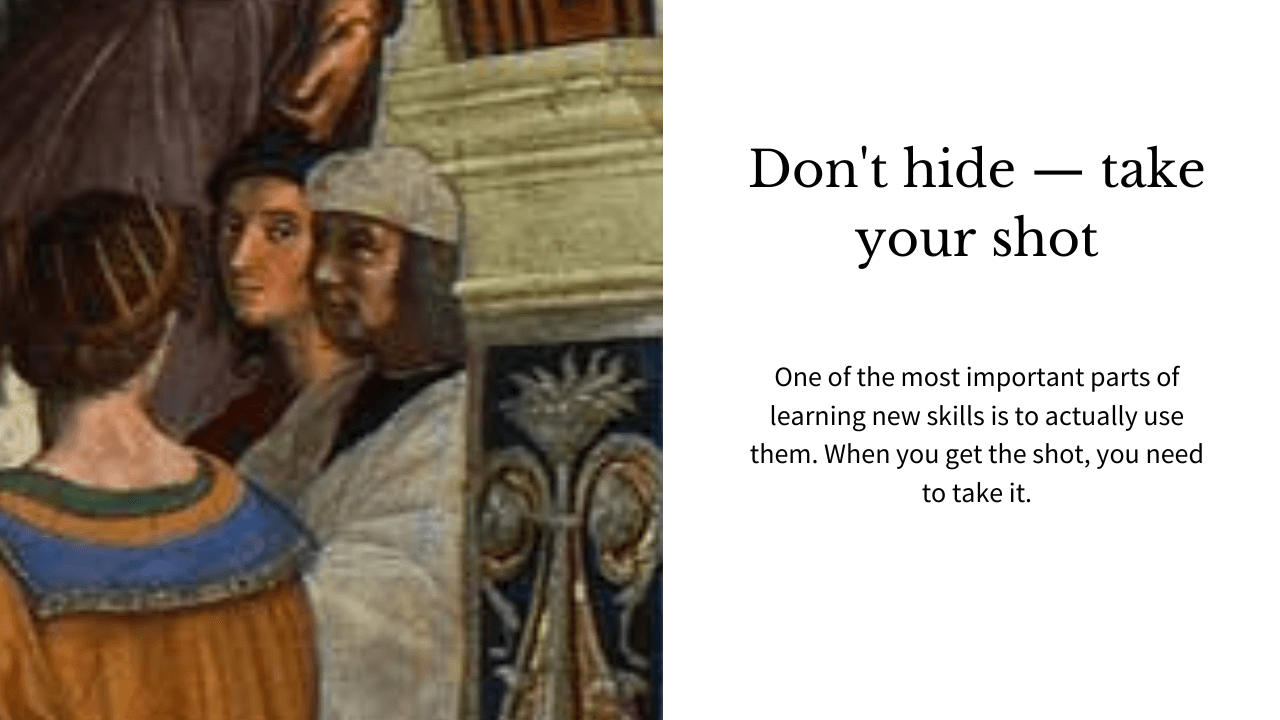
He even painted himself at the far right edge, looking straight at us, with a fellow painter, possibly Sodoma, beside him. Even in his self-portrait, Raphael brought a colleague along.
The same idea runs through our other portraits. Camille Pissarro, the man who could teach stones to draw, taught Paul Cézanne and treated him as a colleague, which is a fairly efficient way to get a Cézanne. Rembrandt's workshop, as we showed in Rembrandt's Other Masterpieces, produced masterpieces by other hands. And Leonardo began as an apprentice to Verrocchio before he became a master, as we described in Leonardo da Vinci's Success Habits.
Making Others Great, painted in 1510
A fresco more than 500 years old still has a lot to tell us. Raphael's philosophers teach, argue, show and listen, and knowledge grows between them. His workshop did the same in real life: a young master who made the people around him better, and let colleagues see it.
So, before the next leadership book: a look at where each person stands, a different order of speakers, and a better question than "Any questions?"
Raphael was in his mid-to-late twenties when he painted this. Some of us are still working on it.
Talent Takeaway
- Give different people different answers. Ask where each person stands before you explain.
- Change the order of speakers. Let someone one step ahead explain first, then let the expert add the rest.
- Replace "Any questions?" with "Who can tell us in two minutes what we decided?"
- Lift your head from the compasses. See who is still kneeling at the bottom of the chain, and who looks after them.
- Give credit where people can see it. The explainer, the mentor, the colleague who helped.
- Build what outlasts you. Develop people who can carry the work forward.
The School of Athens series
Part 1: A Renaissance Guide for Coaches and Leaders
Part 2: Back to School (of Athens)
Part 3: Making Others Great: Lessons from a World-Famous Fresco
¹ Musei Vaticani. School of Athens. Stanza della Segnatura, collection entry. https://www.museivaticani.va/content/museivaticani/en/collezioni/musei/stanze-di-raffaello/stanza-della-segnatura/scuola-di-atene.html
² The reading of the four students as stages of learning is ours, not Raphael's or an established art-historical position.
³ Euclid's dates are uncertain; he is placed in Alexandria around 300 BC. The remark to King Ptolemy comes from a later source, Proclus, Commentary on the First Book of Euclid's Elements (5th century AD), and is traditionally attributed to Euclid.
⁴ Biblioteca Ambrosiana. Raphael, cartoon for the School of Athens. https://www.ambrosiana.it/en/discover/masterpieces/school-of-athens/. The likeness of Leonardo is a tradition, not a documented fact.
⁵ Vasari, G. (1912–1914). Lives of the most eminent painters, sculptors and architects (G. du C. de Vere, Trans.). Macmillan. (Original work published 1550, revised 1568). Life of Raphael of Urbino.
⁶ National Galleries of Scotland. Giulio Romano. https://www.nationalgalleries.org/art-and-artists/artists/giulio-romano-giulio-pippi
Further reading: Roger Jones and Nicholas Penny, Raphael (Yale University Press, 1983); Christiane L. Joost-Gaugier, Raphael's Stanza della Segnatura: Meaning and Invention (Cambridge University Press, 2002).
Images: Raphael, The School of Athens, details; public domain.